
Adults only · Canada
Are you of legal age?
- Free shipping $149+
- Ships in 24 hrs
- Plain packaging
Nicotine is addictive. Orders may require age verification.
Adults only · Canada
Nicotine is addictive. Orders may require age verification.
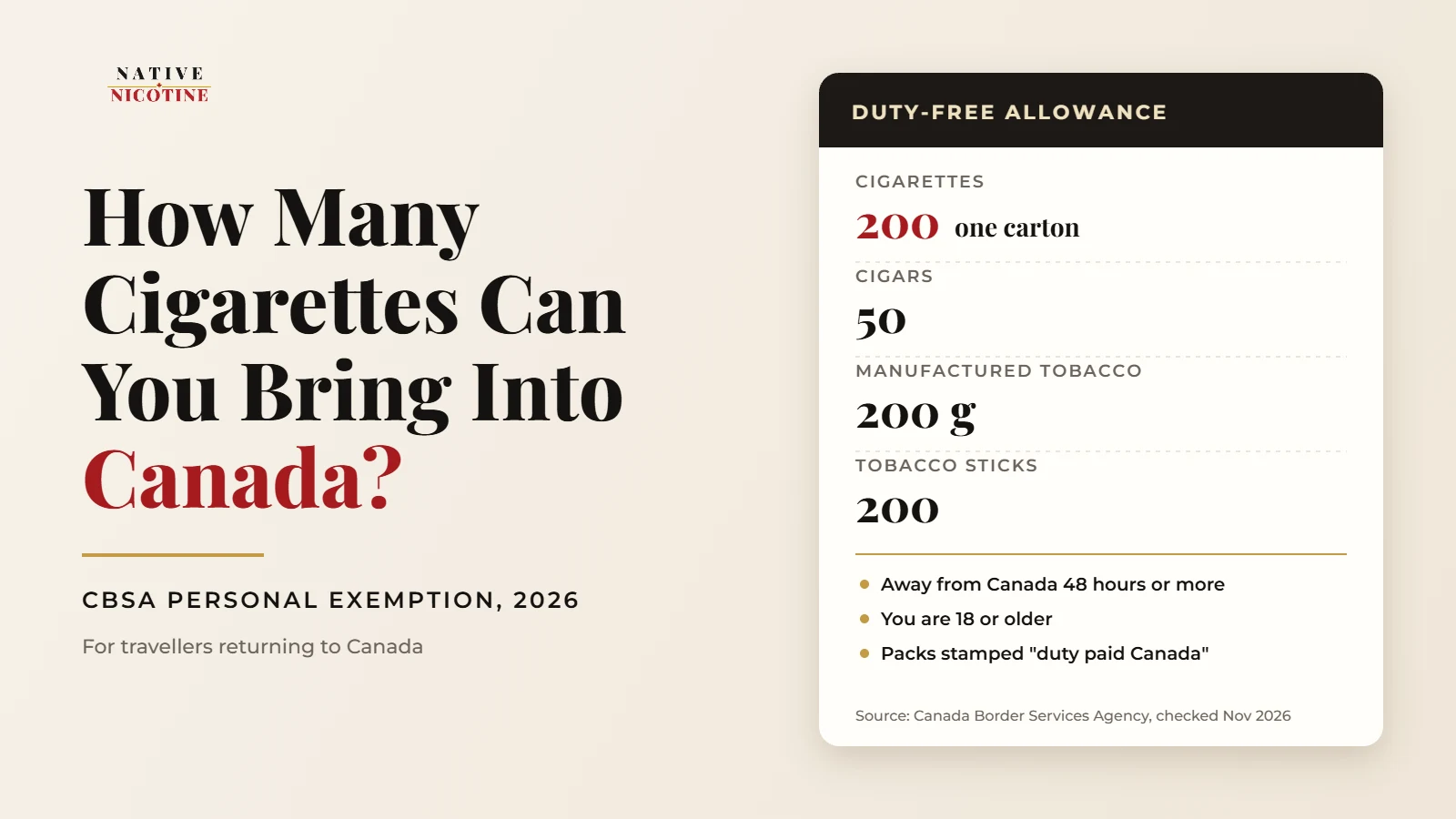
How many cigarettes can you bring into Canada? 200, or one carton. If you have been outside Canada for 48 hours or more, you are 18 or older and the packs are stamped “duty paid Canada droit acquitté”, the Canada Border Services Agency (CBSA) lets you bring in 200 cigarettes free of duty and taxes. The same personal exemption also covers 50 cigars, 200 grams of manufactured tobacco and 200 tobacco sticks. This guide explains each limit, what happens if you go over, and how duty-free shop cigarettes are treated. All rules were checked on CBSA pages on November 16, 2026.
The CBSA tobacco page says that after 48 hours or more away you “may import all of the following amounts” of cigars and stamped tobacco products free of duty and taxes:
| Product | Duty-free allowance | Notes |
|---|---|---|
| Cigarettes | 200 | One standard carton (10 packs of 20). Must be stamped. |
| Cigars | 50 | No stamp requirement listed for cigars. |
| Manufactured tobacco, such as rolling tobacco | 200 grams (7 ounces) | Must be stamped. |
| Tobacco sticks | 200 | Must be stamped. |
Because the page says “all of the following”, the four amounts are separate limits, not a single combined quota. Two conditions apply to every tobacco item:
You also cannot pool exemptions. CBSA says you cannot combine your personal exemptions with another person’s or transfer them to someone else, so two travellers cannot declare one person’s 400 cigarettes as a shared allowance.
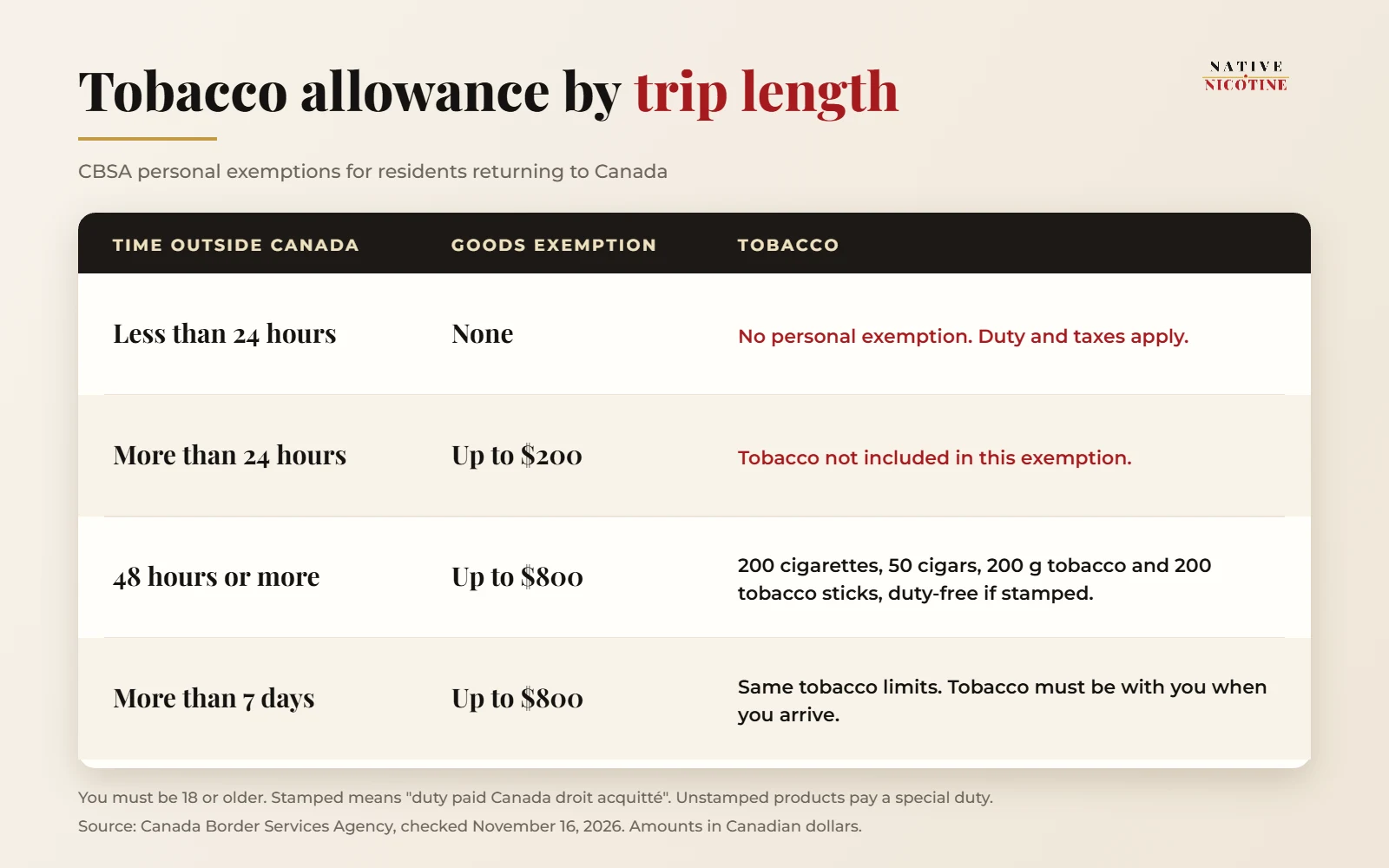
How long you were away decides whether tobacco can be part of your exemption at all. CBSA sets these personal exemptions for Canadian residents, former residents returning to live in Canada and temporary residents returning from a trip:
| Time outside Canada | Goods you can claim | Tobacco |
|---|---|---|
| Less than 24 hours | None. Personal exemptions do not apply to same-day cross-border shoppers. | Duty and taxes apply |
| More than 24 hours | Up to CAN$200 | Not included in this exemption |
| 48 hours or more | Up to CAN$800 | 200 cigarettes, 50 cigars, 200 g of manufactured tobacco and 200 tobacco sticks |
| More than 7 days | Up to CAN$800 | Same limits. Tobacco must be in your possession when you enter Canada |
For the 24 hour exemption, CBSA adds that if the value of the goods you bring back exceeds CAN$200, you cannot claim the exemption, and duty and taxes apply to the full value. Tobacco is left out of that exemption entirely.
Bringing more than the allowance is not banned, but the extra is taxed. CBSA says that whether the products are stamped or unstamped, you will pay “the regular duty and taxes as well as any provincial or territorial levies that apply on the excess amount.” In practice that means declaring everything at the border and paying on the part above 200 cigarettes.
There is also a hard ceiling for unstamped product. Under the Excise Act, CBSA limits the amount of unstamped tobacco an individual may import for personal use to five units, where one unit is 200 cigarettes, 50 cigars, 200 grams of manufactured tobacco or 200 tobacco sticks. The five unit limit sits on top of your personal exemption.
For a sense of what that duty involves: in Canada the federal excise duty alone is $0.97299 per 5 cigarettes (CRA rate from April 1, 2026), or about $38.92 a carton, before provincial tobacco tax and sales tax. Our cigarette prices in Canada guide breaks down the tax by province.
Searches for duty-free cigarettes in Canada usually mean one of two things: buying cartons at an airport or land border duty-free shop, or bringing cigarettes home within your allowance. The stamp is what matters in both cases.
CBSA also suggests having your tobacco ready for inspection when you arrive, which can speed up clearance.
The customs allowance applies however you cross the border. If you are flying, airport security has its own rules on cigarettes, lighters and matches in carry-on and checked bags; see can you bring cigarettes on a plane for the CATSA and airline rules.
If you only want cigarettes once you are home, there is no border allowance to manage. Native Nicotine ships within Canada only, to adults of legal age. Cartons start at $45 for BB and disCOUNT and $49 for most other brands, with free shipping at $149+. Browse the full range in our shop.
This guide summarises federal customs rules for general information. It is not legal or tax advice. Rules can change, so check the CBSA pages below or ask a border services officer before you travel. For the rules on buying at home, see whether native cigarettes are legal in Canada.
You can bring 200 cigarettes into Canada free of duty and taxes if you have been away for 48 hours or more, you are 18 or older and the packs are stamped “duty paid Canada droit acquitté”. You can also bring 50 cigars, 200 grams of manufactured tobacco and 200 tobacco sticks.
Yes, but only one carton (200 cigarettes) is covered by the personal exemption. CBSA charges regular duty, taxes and any provincial or territorial levies on the second carton. Unstamped tobacco is capped at five units per person under the Excise Act.
Not duty-free. Personal exemptions do not apply to same-day cross-border shoppers, and tobacco is not included in the 24 hour exemption. Tobacco only becomes part of your exemption after 48 hours or more away.
Only within your allowance and only if they are stamped “duty paid Canada droit acquitté”. Canadian-made stamped products are sold at duty-free shops. Unstamped cigarettes, for example from a US duty-free shop, pay a special duty even within the 200 cigarette limit.
CBSA says you must be 18 to bring tobacco into Canada under your personal exemption. Provincial laws set the age to buy tobacco, which is 19 in most provinces.
We'll email your code right away.
No spam. Unsubscribe anytime. Adults of legal age only.