
Adults only · Canada
Are you of legal age?
- Free shipping $149+
- Ships in 24 hrs
- Plain packaging
Nicotine is addictive. Orders may require age verification.
Adults only · Canada
Nicotine is addictive. Orders may require age verification.
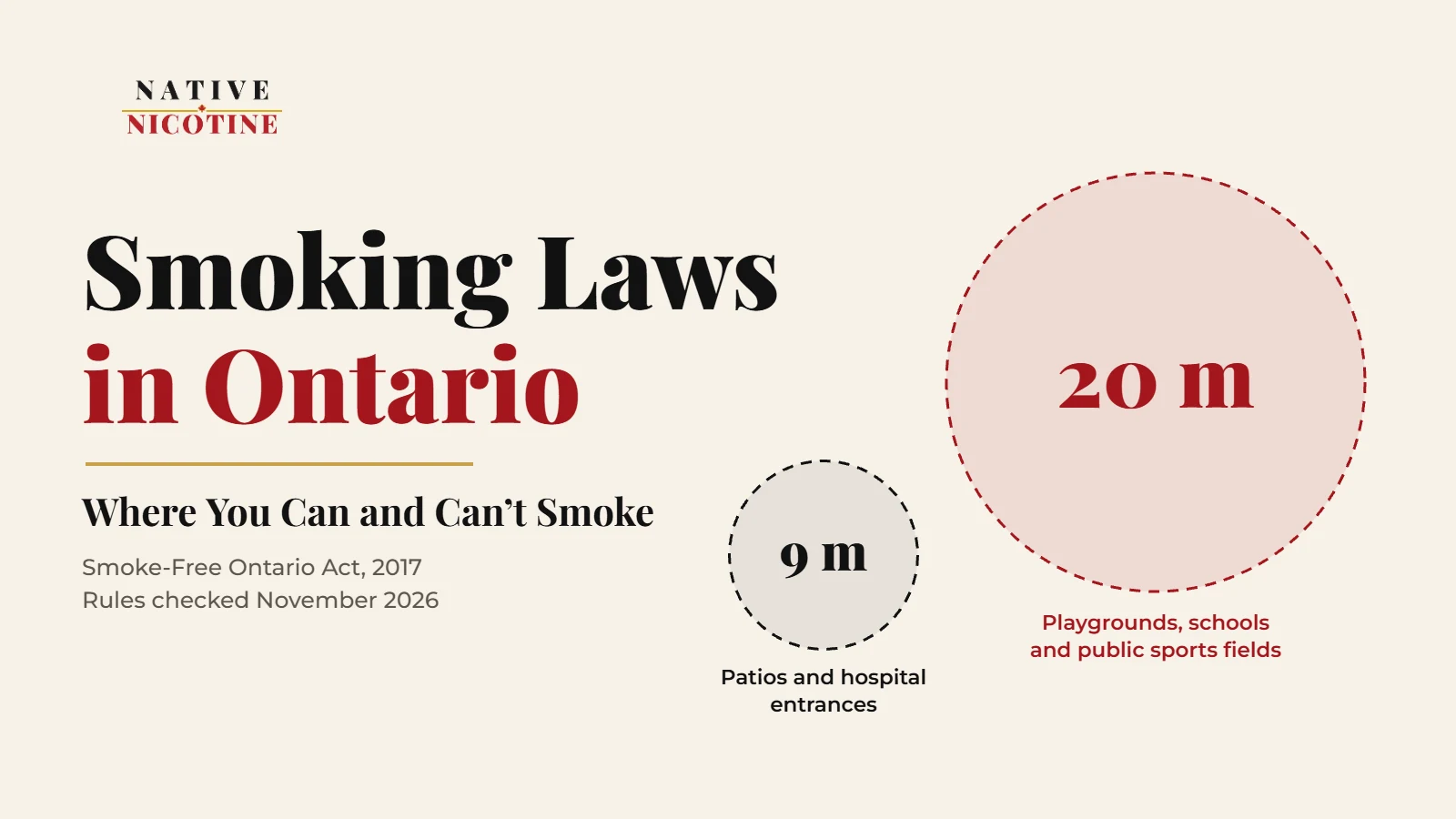
The smoking laws Ontario residents and visitors need to know sit mainly in the Smoke-Free Ontario Act, 2017 and its general regulation, O. Reg. 268/18. In short, you can’t smoke in enclosed public places or enclosed workplaces, on restaurant and bar patios, on school grounds, or within set distances of places such as playgrounds and hospital entrances. You also can’t smoke in a vehicle with anyone under 16.
This guide explains each rule in plain language. We checked the Act and the regulation on e-Laws on November 18, 2026. It is general information, not legal advice.
Section 12 of the Act says that in a listed place, no one may smoke or hold lighted tobacco, smoke or hold lighted cannabis, or use an electronic cigarette. Holding a lit cigarette counts, even if you are not drawing on it. Native Nicotine does not sell cannabis or vapes, but the same place rules apply to them.
The Act names these places directly:
The regulation adds outdoor places, covered in the next sections. The age to buy is a separate rule: our guide to the smoking age in Canada explains why it is 19 in Ontario.
Outdoor rules work in two ways. Some cover the place itself, and many also add a buffer zone around it. The buffer is either 9 metres or 20 metres.
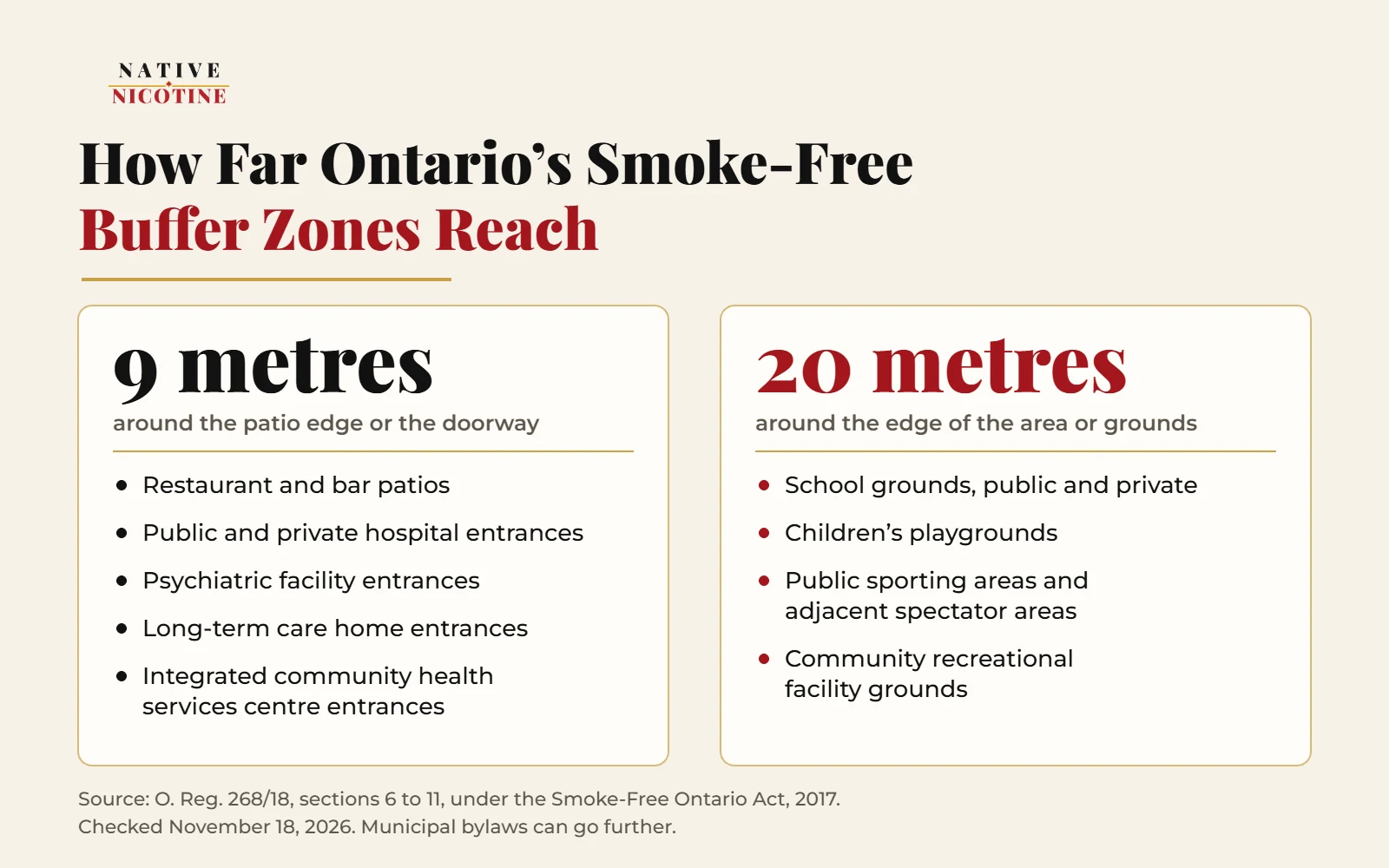
| Place | Where smoking is banned | Rule |
|---|---|---|
| Restaurant and bar patios | On the patio and in public areas within 9 m of its perimeter | O. Reg. 268/18, s. 7 |
| Public and private hospitals, psychiatric facilities | On the outdoor grounds and within 9 m of any entrance or exit | s. 6 |
| Long-term care homes, integrated community health services centres | Within 9 m of any entrance or exit | s. 6 |
| Schools and private schools | On school grounds and in public areas within 20 m of the perimeter | Act, s. 12; O. Reg. s. 11 |
| Children’s playgrounds | On the playground and in public areas within 20 m of its perimeter | s. 8 |
| Publicly owned sporting areas | On the sporting area, in adjacent spectator areas and in public areas within 20 m | s. 9 |
| Community recreational facilities | On the outdoor grounds and in public areas within 20 m of the grounds | s. 11 |
| Public or workplace shelters | Anywhere with a roof and more than two walls, such as a bus shelter | s. 10 |
| Listed provincial office buildings | On the outdoor grounds | s. 6, Schedule 3 |
Smoking is banned on patios where food or drink is served, and within 9 metres of the patio’s edge. There is a narrow exception for tobacco on some Royal Canadian Legion and veterans’ organization patios. The patio must have been operated by the organization since before November 18, 2013, and it can’t be a covered patio as defined in the older rules.
The playground rule covers public play areas with equipment such as slides, swings or splash pads. It does not cover a playground that is an amenity of an apartment, condominium complex or campground, although a hotel or motel playground does count. The sporting area rule applies to areas owned by the province, a municipality or a post-secondary institution, and it excludes golf.
Section 17 bans smoking tobacco or having lighted tobacco in a motor vehicle while anyone under 16 is present. The ban applies to everyone in the vehicle, not only the driver, and Ontario’s guidance describes it as anyone age 15 or younger. Police officers enforce it, and the maximum fine on conviction is $250.
The Act bans smoking in the indoor common areas of multi-unit buildings, but Ontario says it is allowed in your own home unless a lease or condominium rule says otherwise. A tenant affected by a neighbour’s smoke can raise it with the landlord and may apply to the Landlord and Tenant Board. If you provide home child care, the ban applies at all times.
In hotels, motels and inns, smoking is allowed only in fully enclosed guest rooms that management has designated for it, and only by registered guests and their invited guests.
The Act lists where smoking is banned rather than where it is allowed. Outside the places above, provincial law generally does not stop an adult from smoking outdoors. Two other layers can still apply:
Travelling through Toronto? Our guide to smoking areas at Canadian airports covers the designated outdoor areas at Pearson.
These are the maximum fines for an individual on conviction under section 21 of the Act. The amount ordered in a given case can be lower.
| Offence | First conviction | Earlier conviction for the same offence in the past 5 years |
|---|---|---|
| Smoking in a prohibited place (s. 12) | Up to $1,000 | Up to $5,000 |
| Smoking in a vehicle with someone under 16 (s. 17) | Up to $250 | Up to $250 |
Section 19 recognizes the traditional use of tobacco in Indigenous culture and spirituality. Smoking bans do not stop an Indigenous person from smoking tobacco for traditional cultural or spiritual purposes, or a non-Indigenous person from doing so with them. On request, hospitals, long-term care homes and certain other facilities must set aside an indoor area for an Indigenous resident’s traditional use.
For the wider legal picture on buying, see whether native cigarettes are legal in Canada. For costs, see how much a pack of cigarettes costs in Ontario. Adults can also read about native cigarette delivery in Ontario or browse the Native Nicotine shop.
No, not on a restaurant or bar patio. Smoking is banned on the patio and in public areas within 9 metres of its perimeter. A narrow exception covers tobacco on some long-standing Royal Canadian Legion and veterans’ organization patios.
The provincial rules do not set one distance for every building. The 9 metre rule applies to entrances and exits of hospitals, psychiatric facilities, long-term care homes and integrated community health services centres. Schools and community recreational facilities have 20 metre buffers around their grounds. A municipal bylaw or the property owner may set other limits.
No. It is illegal to smoke tobacco or have lighted tobacco in a motor vehicle while anyone under 16 is present. The maximum fine on conviction is $250.
Ontario says smoking is allowed in your own home unless a lease or condominium rule says otherwise. It is banned in indoor common areas such as hallways, elevators, lobbies, laundry rooms and parking garages.
For an individual, the maximum fine on conviction is $1,000. It rises to $5,000 if the person has an earlier conviction for the same offence in the previous five years.
We'll email your code right away.
No spam. Unsubscribe anytime. Adults of legal age only.