
Adults only · Canada
Are you of legal age?
- Free shipping $149+
- Ships in 24 hrs
- Plain packaging
Nicotine is addictive. Orders may require age verification.
Adults only · Canada
Nicotine is addictive. Orders may require age verification.
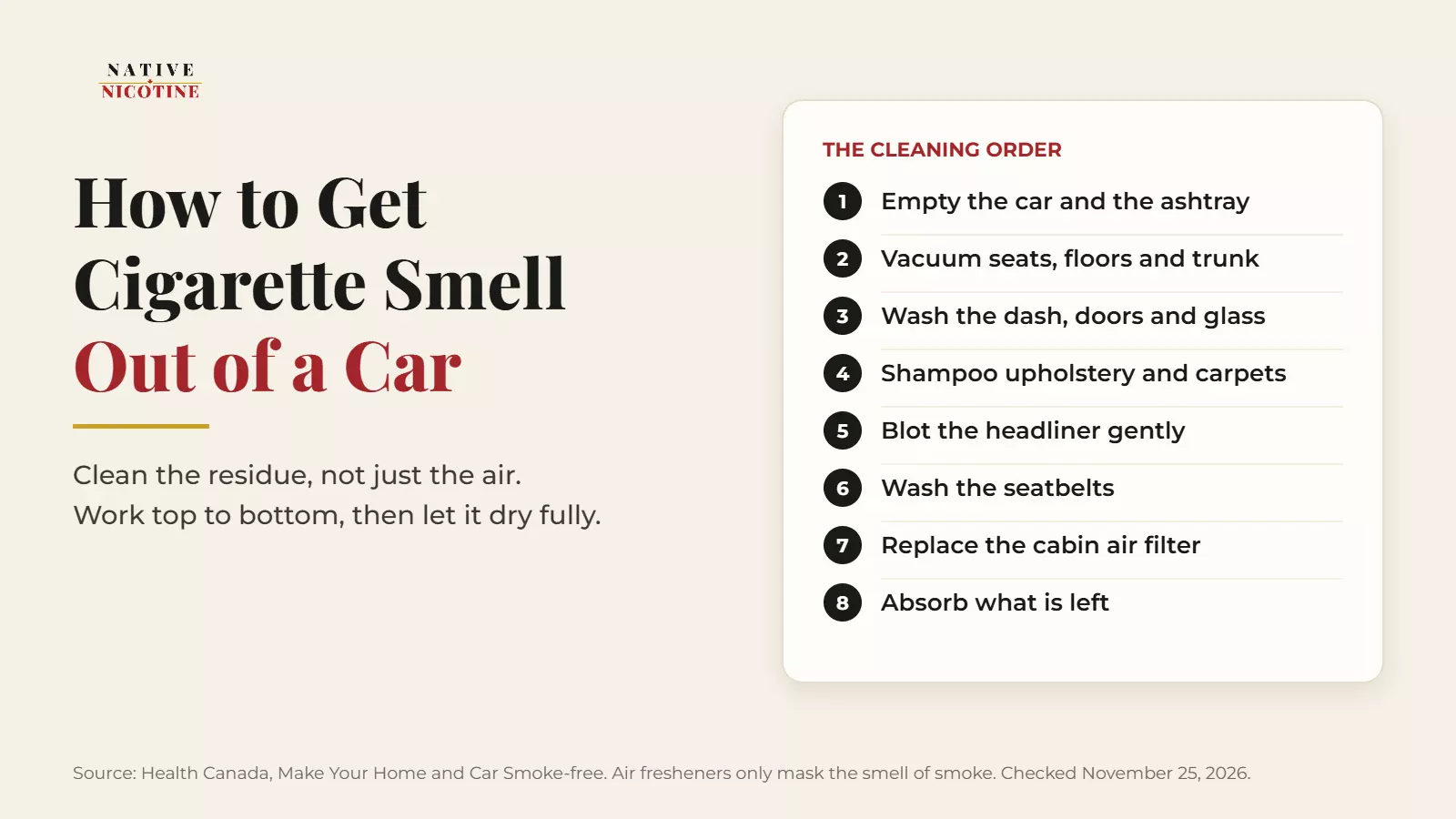
Cigarette smell in a car is not just stale air. Smoke leaves a sticky residue on every surface inside the cabin, and that residue keeps releasing odour long after the last cigarette. This guide covers how to get cigarette smell out of car seats, carpets, vents and the headliner, in the order that works, plus what only covers the smell up.
It is part of our guide to storing cigarettes and keeping them fresh, which also explains why a car is one of the worst places to leave a carton. Facts on smoke residue below come from Health Canada and Alberta Health Services, checked November 25, 2026.
Short answer: empty the car, vacuum everything, wash the hard surfaces and the inside of the glass, shampoo the upholstery and carpets, clean the headliner and seatbelts gently, replace the cabin air filter, then leave baking soda or activated charcoal inside for a few days. Air fresheners and open windows do not remove the residue.
When someone smokes, part of the smoke settles out of the air onto surfaces. Public health agencies call this residue thirdhand smoke. MyHealth.Alberta.ca (Alberta Health Services) describes it as toxic residue that settles on surfaces after someone smokes and says it can linger “from minutes to months.”
A car makes the problem worse for three reasons. The cabin is small, so the smoke is concentrated; Health Canada notes that smoking in an enclosed space such as a car greatly increases the concentration of harmful chemicals. The cabin is full of fabric and foam that absorb it. And the ventilation system pulls smoky air through the vents and the cabin air filter, which then blow it back out every time the fan runs.
Health Canada also says smoke chemicals remain in dust and on surfaces even if the smoking happened days, weeks or months earlier. That is why a car can still smell after you stop smoking in it, and why cleaning beats masking.
Work from the top down and from the dirtiest items out. Dust and dirty water fall, so cleaning the carpet first and the dash second just means doing the carpet twice.
Take out everything: floor mats, seat covers, trunk liners, papers, and anything in the door pockets and console. Throw out butts, ash and packaging. Wash the ashtray in hot soapy water, or remove it if your car allows. Health Canada’s own advice for making a car smoke-free is to get rid of the ashtray or clean it out. Ash in the cup holders and seat rails is a common source of the smell, so check them.
Vacuum the seats, the seams and the gaps between the cushions, under the seats, the carpets, the trunk and the parcel shelf. Slide the front seats all the way forward and back so you can reach the rails. Use the brush head on the dash and the vents. Ash and fine dust hold a lot of the odour, so a slow, thorough pass matters more than strong suction.
Wipe the dash, console, steering wheel, door panels, handles, vents and pillars with a damp microfibre cloth and mild soapy water or an interior cleaner. Rinse the cloth often. Then clean the inside of every window and mirror. Smoke leaves a yellowish film on glass, and if your cloth comes away tinted, keep going until it comes away clean. Check your owner’s manual before using anything strong on screens, leather or soft touch plastics.
Fabric seats and carpets hold the most odour. Shampoo them with an upholstery cleaner or an enzyme cleaner, working one section at a time, then pull out as much water as you can with a wet vacuum or extractor. Wash the floor mats separately. The key is drying: leave the doors or windows open on a dry day, or run the heater, until the foam is dry all the way through. Damp foam can start to smell musty, which you do not want to trade for smoke. For leather, use a leather cleaner and conditioner instead of shampoo.
The fabric on the roof catches rising smoke and is easy to miss. It is also glued in place, and soaking it can loosen the adhesive and make it sag. Spray a foam upholstery cleaner onto a microfibre cloth, not onto the headliner, and blot gently in one direction. Do the sun visors the same way. If the headliner is badly stained, this is a good job to hand to a detailer.
Pull each belt all the way out and clip the end so it cannot retract. Wipe both sides with warm soapy water, then let the belts dry fully extended before you let them roll back in. A damp belt rolled up on the spool can smell musty and dry slowly.
The cabin air filter has been filtering smoky air for as long as anyone smoked in the car. Replacing it is cheap and usually takes a few minutes; your owner’s manual shows where it is, often behind the glove box. With the new filter in, run the fan on high with the windows down for a while to push out any stale air in the ducts.
Once everything is dry, sprinkle baking soda over the carpets and fabric seats, leave it overnight, and vacuum it up. Activated charcoal bags left in the car for a few days also soak up remaining odour. These work best after cleaning, as a last step, not as a replacement for it.
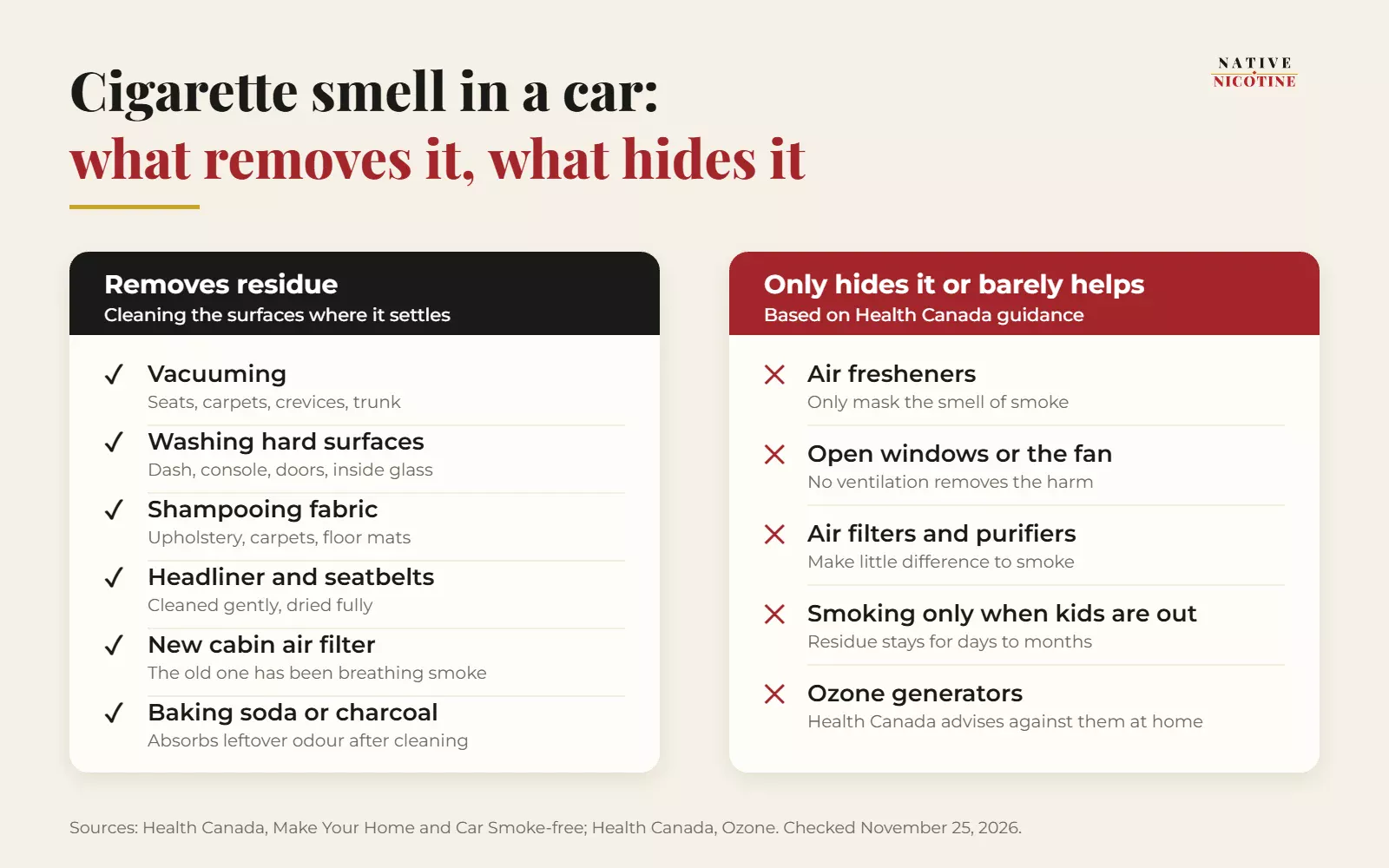
Health Canada’s guide Make Your Home and Car Smoke-free is blunt about the shortcuts most people try first:
If a car still smells after a quick wipe and a new air freshener, that is why. The smell is coming from the seats, carpet, headliner and filter, and only cleaning those changes it.
If the car was smoked in heavily for years, or the steps above leave a smell behind, a professional interior detail is the next step. Detailers have hot water extractors and steam cleaners that reach deeper into the foam than household tools. Even then, Health Canada notes it is very difficult to remove all traces of smoking from a car, so ask the detailer what result to expect before you book.
Some detailers use ozone machines for smoke odour. Health Canada advises against using ozone generators in homes because the ozone they produce may harm your health and they create other dangerous chemicals. If a detailer uses one on your car, keep people and pets out of the car while it runs and ask how long to air it out before anyone gets back in. Do not run an ozone machine in a car you are sitting in.
Smoke smell can be hard to judge on a short test drive, especially if the seller has used a strong air freshener. Look for ash in the seat rails and vents, burn marks on the seats or carpet, a yellow film on the inside of the windshield, and staining on the headliner. Turn the fan on high: stale smoke smell often comes out of the vents. If you buy it anyway, budget for a thorough clean and a new cabin air filter. Health Canada also notes that a smoke-free car will likely have a higher resale value.
The only way to keep a car from smelling of smoke is not to smoke in it. If you smoke, finishing your cigarette outside before you get in, and keeping the ashtray empty, stops the residue from building up again.
In many places it is also the law when children are in the car. Health Canada says several provinces and territories ban smoking in vehicles with children, with age limits from 16 to 19 depending on where you are. In Ontario the ban covers anyone under 16, as our guide to smoking laws in Ontario explains, and Alberta bans smoking or vaping in a vehicle with a passenger under 18. Check your own province or territory’s rules.
Some adults who use nicotine choose a format that does not produce smoke while driving. Our comparison of nicotine pouches vs cigarettes sets out the differences without health claims. If you buy cartons from the Native Nicotine shop, store them indoors at a steady room temperature rather than in the glove box or trunk.
Without cleaning, a long time. Health Canada says smoke chemicals stay in dust and on surfaces for days, weeks or months after smoking, and Alberta Health Services says the residue can linger from minutes to months. A thorough clean of the fabric, hard surfaces and cabin air filter is what shortens it.
Baking soda helps absorb leftover odour from carpets and fabric seats when you leave it overnight and vacuum it up. It works best as the last step after vacuuming, washing and shampooing. On its own it will not remove the residue on the dash, glass, headliner or cabin air filter.
Usually, if you clean it gently. Spray a foam upholstery cleaner onto a microfibre cloth and blot the headliner rather than soaking it, because too much moisture can loosen the glue and make it sag. Heavily stained headliners are a good job for a professional detailer.
No. Health Canada says air fresheners only mask the smell of smoke. Opening windows, running the fan and using air filters also make little or no difference to smoke residue. Cleaning the surfaces where it settles is what removes the smell.
In many places, yes. Health Canada says several provinces and territories ban smoking in vehicles with children, with age limits from 16 to 19. Ontario bans it with anyone under 16 in the vehicle, and Alberta with a passenger under 18. Check the rules where you live.
Sources, checked November 25, 2026: Health Canada, Make Your Home and Car Smoke-free (2021); Health Canada, Ozone; MyHealth.Alberta.ca, How smoking and vaping affect others (current as of August 17, 2026). This guide is general cleaning information, not medical advice.
We'll email your code right away.
No spam. Unsubscribe anytime. Adults of legal age only.