
Adults only · Canada
Are you of legal age?
- Free shipping $149+
- Ships in 24 hrs
- Plain packaging
Nicotine is addictive. Orders may require age verification.
Adults only · Canada
Nicotine is addictive. Orders may require age verification.
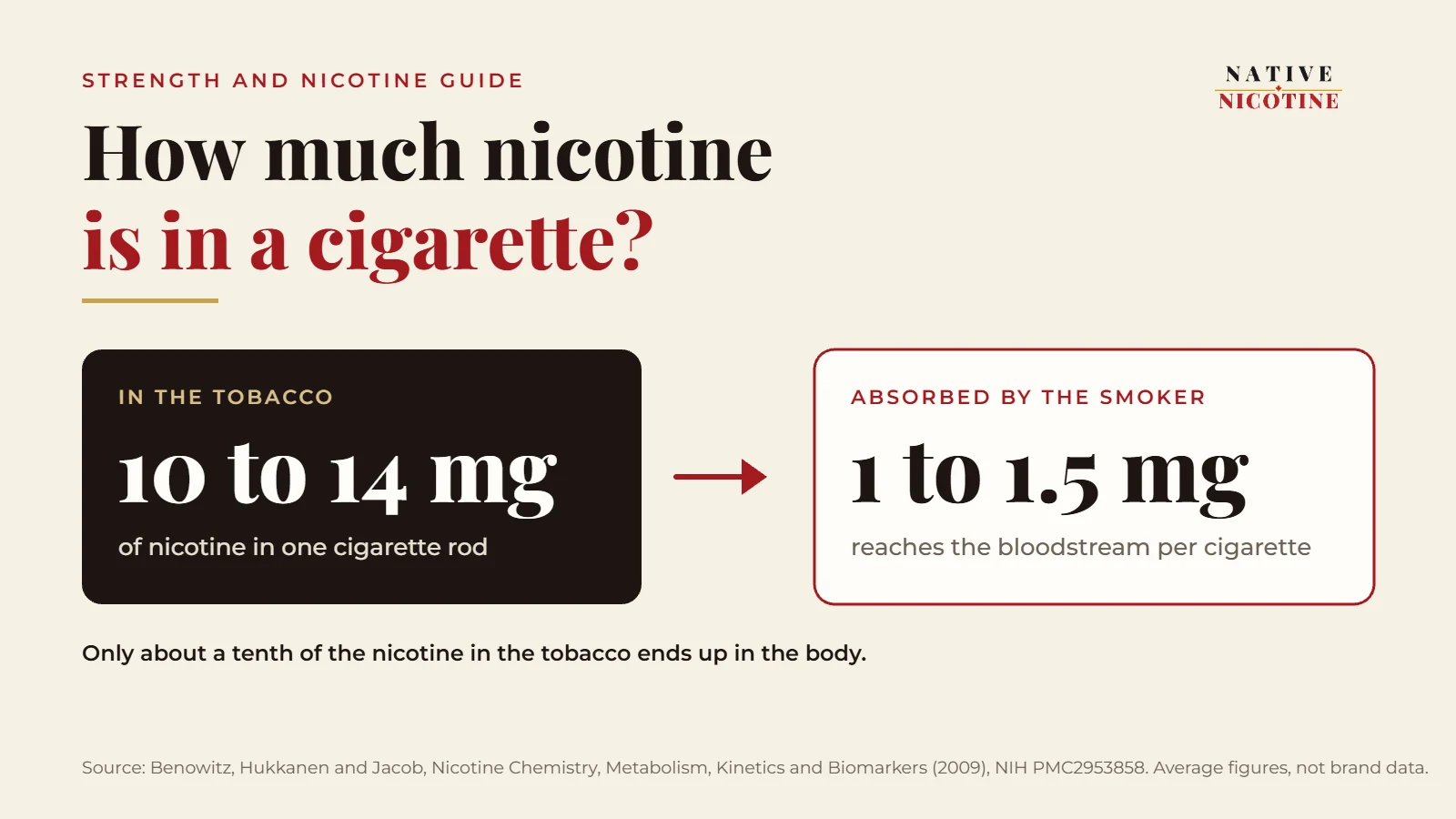
Quick answer: how much nicotine in a cigarette depends on what you measure. The tobacco in an average cigarette holds about 10 to 14 mg of nicotine, but a smoker absorbs only about 1 to 1.5 mg per cigarette. Those are the averages in a widely cited NIH-hosted review of nicotine science (Benowitz, Hukkanen and Jacob, 2009). The rest never reaches the bloodstream.
That gap explains most of the confusion online, where you will see figures anywhere from 1 mg to 20 mg. This guide sits in our native cigarette strength guide series, which explains how full flavour, light-style and menthol profiles differ in taste. Here we stick to the numbers: content versus intake, totals for a pack, how long nicotine stays in the body and how a patch compares.
All figures are general averages for cigarettes, checked on November 26, 2026. They are not lab results for any brand, and this page is not medical advice.
There are two honest answers, and both appear in the research:
| What is measured | Average amount | What it means |
|---|---|---|
| Nicotine in the tobacco rod | 10 to 14 mg | Everything in the unlit cigarette |
| Nicotine absorbed by the smoker | 1 to 1.5 mg | What reaches the bloodstream from one cigarette |
| Share that reaches the body | Roughly a tenth | 1 to 1.5 mg out of 10 to 14 mg |
The NIH review puts the rod at 10 to 14 mg and the absorbed dose at 1 to 1.5 mg. Cancer Council Victoria’s Tobacco in Australia reference cites 1990s research that found an average of about 10 mg per cigarette (Tobacco in Australia, section 6.2). So when someone asks how many mg of nicotine are in one cigarette, the useful reply is “about 10 to 14 mg in it, about 1 to 1.5 mg into you.”
Most of the nicotine in the rod never gets into the body. Some is carried off in smoke that drifts from the lit end between puffs, some stays in the butt that is put out, and some is breathed back out. Of the nicotine that is inhaled into the lungs, the NIH review lists bioavailability at 80 to 90 percent, which is why the lungs deliver it so efficiently once it gets there.
The absorbed amount also varies from person to person. The same review notes that machine-measured nicotine yields cannot be used to estimate the dose a smoker takes in, because people smoke differently: how hard and how often they puff, how deeply they inhale and how far down they smoke each cigarette all change the result.
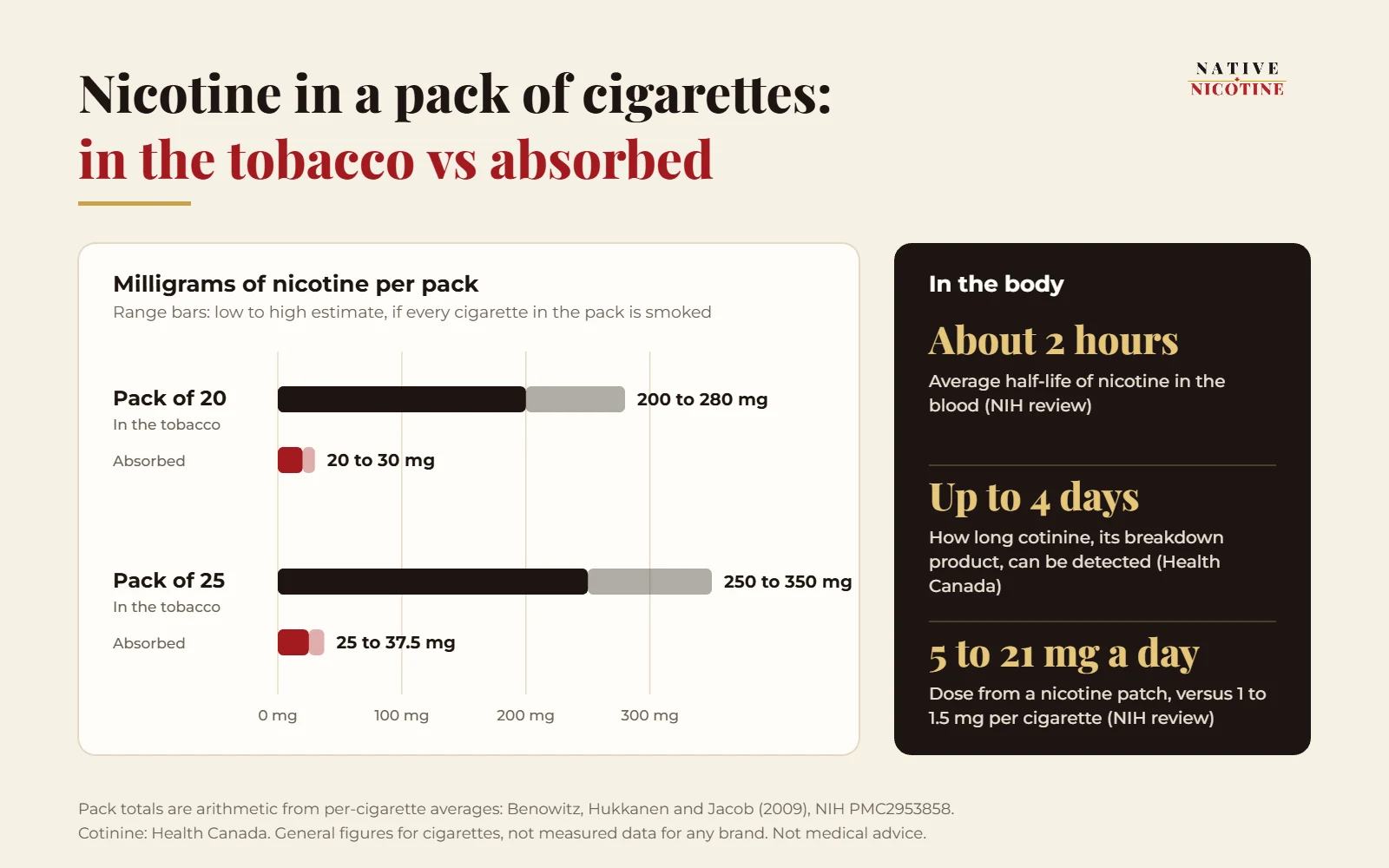
Multiply the per-cigarette averages by the pack size and you get these totals. They assume every cigarette in the pack is smoked, and they are arithmetic, not measurements:
| Pack size | Nicotine in the tobacco | Nicotine absorbed |
|---|---|---|
| Pack of 20 | 200 to 280 mg | 20 to 30 mg |
| Pack of 25 | 250 to 350 mg | 25 to 37.5 mg |
Tobacco in Australia notes that a typical daily smoker absorbs 20 to 40 mg of nicotine over a day, which lines up with the absorbed column for a pack of 20 to 25 cigarettes. For pack sizes and carton counts, see our guide to how many cigarettes are in a pack in Canada.
Canadian cigarette packs once printed numerical ranges for tar, nicotine and carbon monoxide. The Tobacco Products Labelling Regulations (Cigarettes and Little Cigars), published in the Canada Gazette in October 2011, replaced those numbers with four text-based statements about toxic substances in tobacco smoke (SOR/2011-177). Health Canada’s consultations found most respondents favoured a simpler approach over the numerical ranges.
That fits the science above: a machine yield printed on a pack does not tell you what a person absorbs. Our Canadian cigarette packaging guide covers the current warning and labelling rules in detail.
Not in any way you can rely on. A light-style name describes taste and draw, not the nicotine dose you take in. The NIH review notes that smokers who switch from a higher-yield to a lower-yield cigarette tend to compensate by changing how they smoke to get more nicotine. A light-style cigarette is a taste preference, not a lower nicotine dose and not a lower risk.
If you prefer a milder taste, our best light native cigarettes roundup compares the light-style options by flavour and draw, and Canadian Full vs Lights vs Menthol shows how one brand’s three profiles differ. Neither ranks products by nicotine, because no product-specific lab data exists for them.
The NIH review lists the daily dose from a nicotine patch at 5 to 21 mg, depending on the patch, against 1 to 1.5 mg per cigarette. Simple division puts a 21 mg patch at roughly the absorbed nicotine of 14 to 21 cigarettes over a day.
That arithmetic is only a rough guide. A patch releases nicotine slowly and steadily, while a cigarette delivers it in quick peaks, and people absorb different amounts. Choosing a patch strength is a decision for a pharmacist or doctor, who can match it to how much you smoke.
There is no published, independent lab data on the nicotine content of the brands we carry, so we do not give nicotine figures for them, and you should be wary of any seller that does without a test report. What we can describe is taste: our strength guide groups BB, Canadian, Canadian Classics, Playfare and the other brands into full flavour, light-style and menthol profiles. You can compare them all in the Native Nicotine shop.
The tobacco in an average cigarette contains about 10 to 14 mg of nicotine, but a smoker absorbs only about 1 to 1.5 mg of it, according to a widely cited NIH-hosted review (Benowitz, Hukkanen and Jacob, 2009).
Using the published averages, a pack of 20 holds about 200 to 280 mg of nicotine in the tobacco, and a person who smokes the whole pack absorbs about 20 to 30 mg. These are estimates, not measurements of any brand.
Not reliably. Light-style names describe taste and draw. Research shows smokers who switch to lower-yield cigarettes tend to compensate by changing how they smoke, so the nicotine they absorb is not reliably lower.
Nicotine itself has an average half-life of about 2 hours. Cotinine, its main breakdown product, can be detected for up to four days after exposure, according to Health Canada.
Dividing a 21 mg daily patch dose by 1 to 1.5 mg absorbed per cigarette gives roughly 14 to 21 cigarettes a day. A patch delivers nicotine differently, so ask a pharmacist or doctor to choose the right strength.
We'll email your code right away.
No spam. Unsubscribe anytime. Adults of legal age only.