
Adults only · Canada
Are you of legal age?
- Free shipping $149+
- Ships in 24 hrs
- Plain packaging
Nicotine is addictive. Orders may require age verification.
Adults only · Canada
Nicotine is addictive. Orders may require age verification.
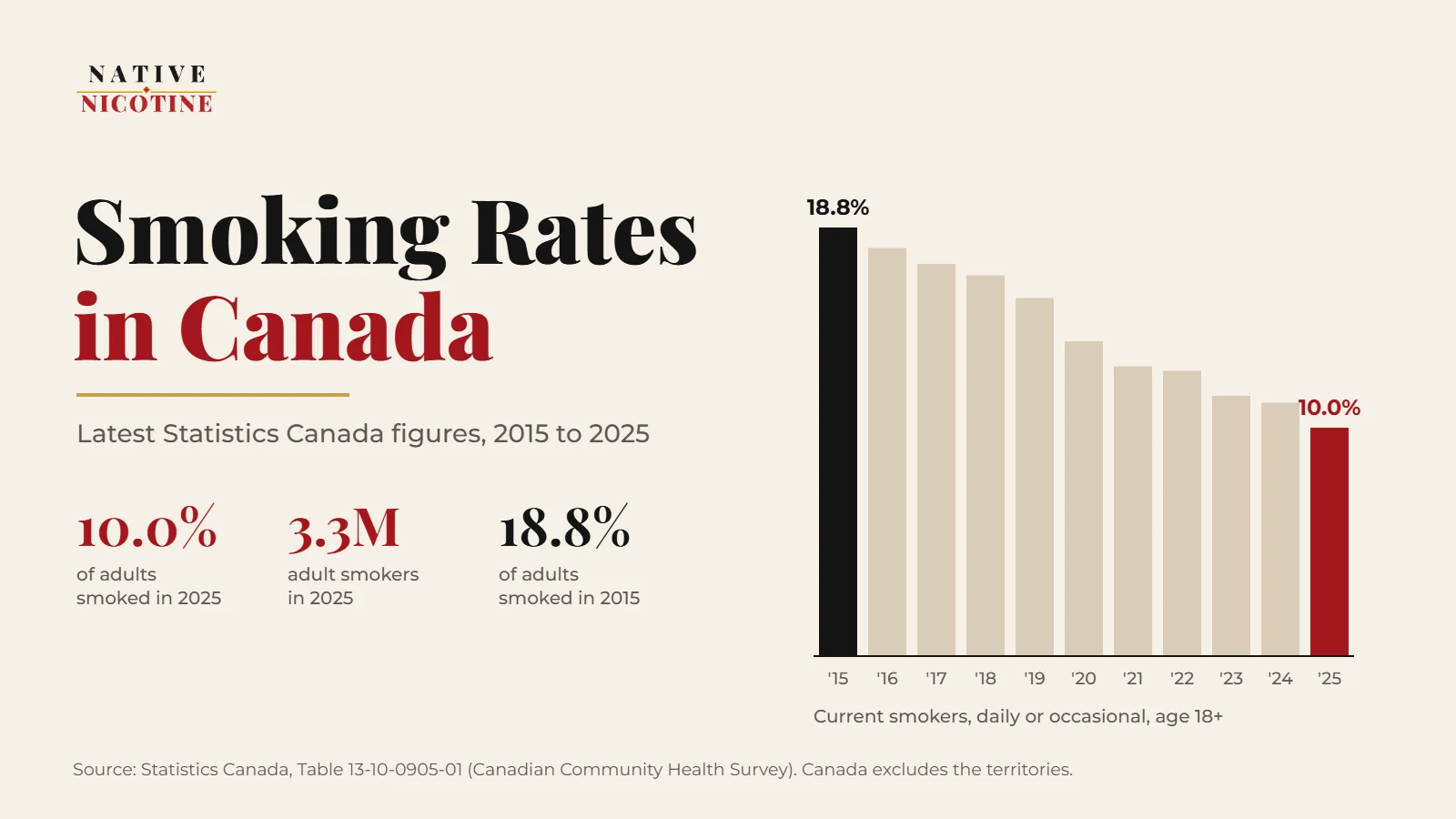
Smoking rates in Canada reached 10.0% of adults in 2025, the lowest figure in Statistics Canada’s current annual series. That works out to about 3.3 million people aged 18 and over in the 10 provinces, and about 2.4 million of them smoke every day. In 2015, the rate was 18.8%.
The figures below come from Statistics Canada Table 13-10-0905-01, released October 20, 2026, which draws on the Canadian Community Health Survey. They were checked on November 18, 2026. The table counts cigarette smoking only, and its Canada total excludes the territories.
| Measure, adults 18 and over, 2025 | Result |
|---|---|
| Current smokers, daily or occasional | 10.0% (3,301,700 people) |
| 95% confidence interval | 9.5% to 10.5% |
| Daily smokers | 7.2% (2,391,400 people) |
| Occasional smokers (current minus daily) | About 2.8% (about 910,300 people) |
| Change from 2024 | Down from 11.1%, a statistically significant drop |
About 72% of current smokers in the 2025 estimate smoke daily. Statistics Canada counts anyone who reports smoking cigarettes daily or occasionally as a current smoker, whatever the number of cigarettes smoked.
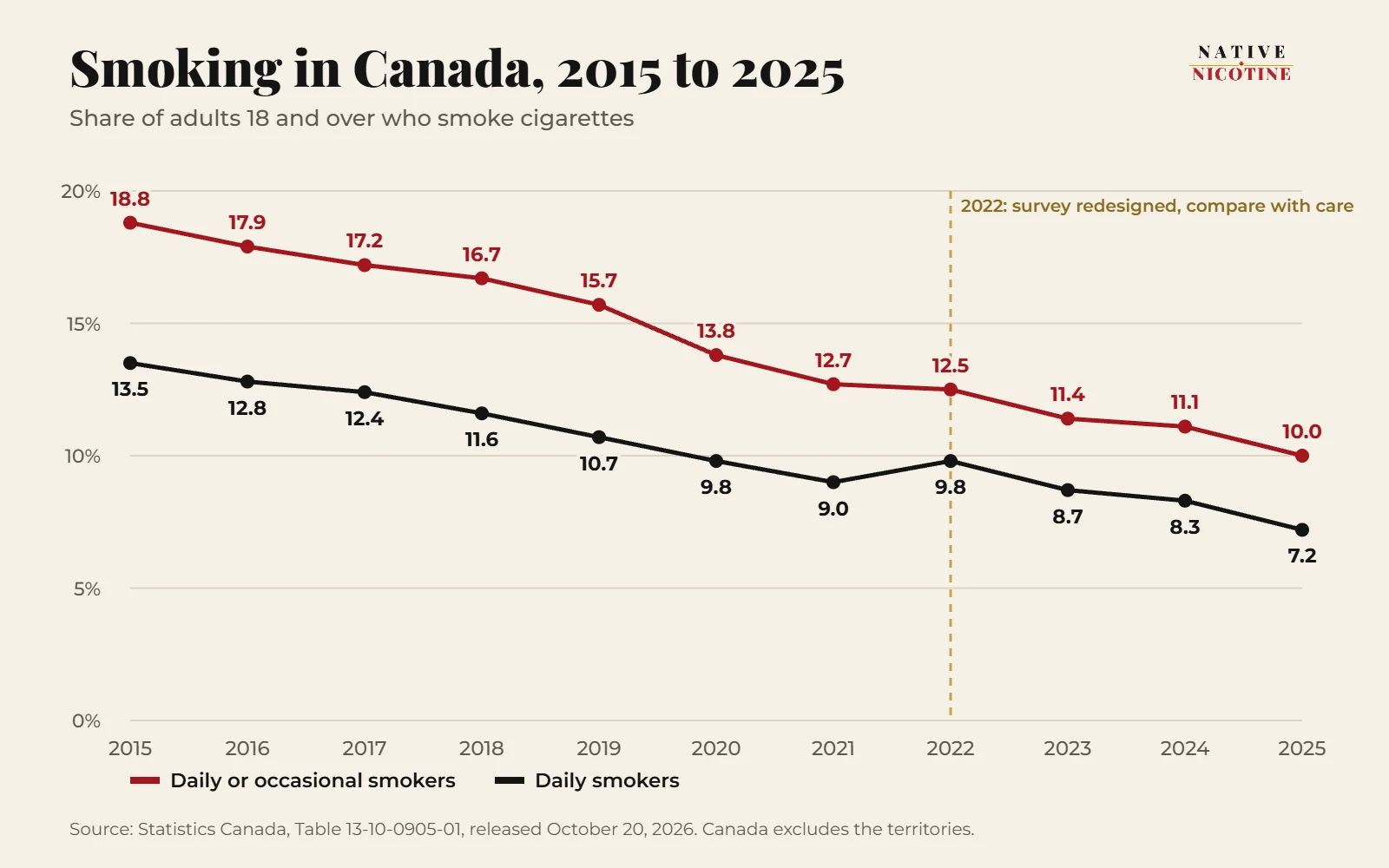
| Year | Current smokers | Daily smokers | Number of current smokers |
|---|---|---|---|
| 2015 | 18.8% | 13.5% | 5,252,000 |
| 2016 | 17.9% | 12.8% | 5,079,600 |
| 2017 | 17.2% | 12.4% | 4,928,900 |
| 2018 | 16.7% | 11.6% | 4,856,000 |
| 2019 | 15.7% | 10.7% | 4,627,500 |
| 2020 | 13.8% | 9.8% | 4,116,800 |
| 2021 | 12.7% | 9.0% | 3,803,300 |
| 2022 | 12.5% | 9.8% | 3,796,900 |
| 2023 | 11.4% | 8.7% | 3,557,700 |
| 2024 | 11.1% | 8.3% | 3,612,700 |
| 2025 | 10.0% | 7.2% | 3,301,700 |
The estimated number of adult smokers is about 1.95 million lower than in 2015. Year-to-year moves need some care, for three reasons Statistics Canada flags in its table notes:
Statistics Canada marks the 2025 drop as statistically significant. The 2024 change was not. The table reports what people said; it does not explain why the rate moved.
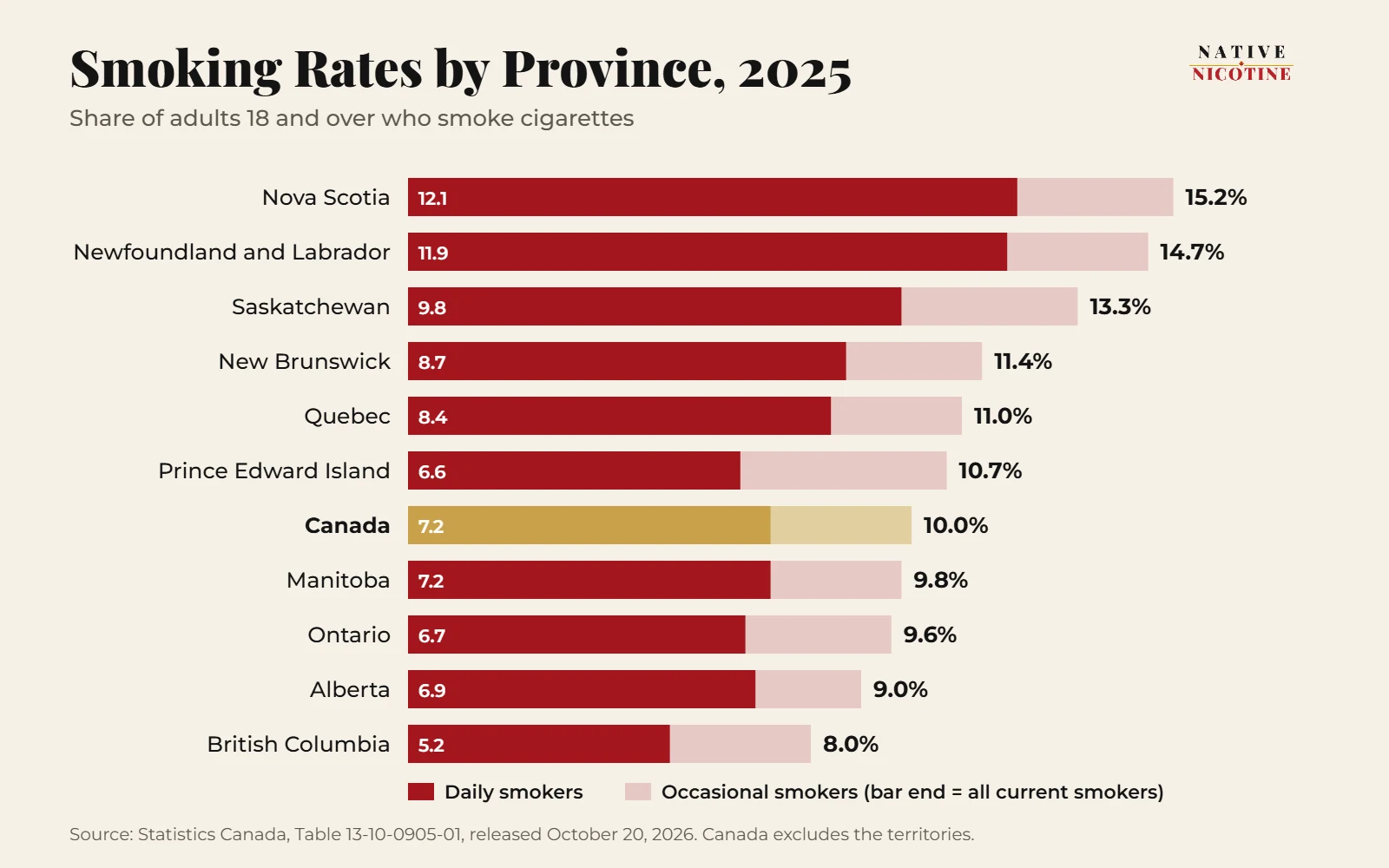
| Province | Current smokers | 95% confidence interval | Daily smokers | Number of current smokers |
|---|---|---|---|---|
| Nova Scotia | 15.2% | 12.9% to 17.8% | 12.1% | 133,300 |
| Newfoundland and Labrador | 14.7% | 12.3% to 17.5% | 11.9% | 66,900 |
| Saskatchewan | 13.3% | 11.3% to 15.5% | 9.8% | 122,000 |
| New Brunswick | 11.4% | 9.6% to 13.6% | 8.7% | 79,100 |
| Quebec | 11.0% | 10.0% to 12.1% | 8.4% | 799,800 |
| Prince Edward Island | 10.7% | 8.0% to 14.1% | 6.6% | 15,700 (use with caution) |
| Canada (excluding territories) | 10.0% | 9.5% to 10.5% | 7.2% | 3,301,700 |
| Manitoba | 9.8% | 8.5% to 11.4% | 7.2% | 110,500 |
| Ontario | 9.6% | 8.8% to 10.5% | 6.7% | 1,257,300 |
| Alberta | 9.0% | 7.8% to 10.3% | 6.9% | 347,000 |
| British Columbia | 8.0% | 7.0% to 9.1% | 5.2% | 370,000 |
Statistics Canada finds the rate significantly above the national figure in Nova Scotia, Newfoundland and Labrador, Saskatchewan and Quebec, and significantly below it in British Columbia. The other five provinces are not statistically different from Canada as a whole. Smaller provinces have wider margins, so close rankings such as Nova Scotia and Newfoundland and Labrador should not be read as firm.
Ontario has the most smokers by count because of its population, even with a rate just under the national figure. Tobacco taxes differ by province as well; our guide to cigarette prices in Canada sets them out.
| Group, 2025 | Current smokers | 95% confidence interval | Daily smokers |
|---|---|---|---|
| 18 to 34 | 8.4% | 7.5% to 9.5% | 3.9% |
| 35 to 49 | 10.8% | 9.9% to 11.8% | 8.0% |
| 50 to 64 | 12.6% | 11.5% to 13.7% | 10.4% |
| 65 and over | 8.6% | 8.0% to 9.2% | 7.6% |
| Males, 18 and over | 11.6% | 10.9% to 12.3% | 8.3% |
| Females, 18 and over | 8.4% | 7.8% to 9.0% | 6.2% |
Adults aged 50 to 64 have the highest rate. The youngest group has the lowest daily rate by a wide margin: fewer than half of its current smokers smoke every day, compared with close to nine in ten among those 65 and over.
This table starts at 18. For younger people, the most recent Canadian Tobacco and Nicotine Survey summary (2022) put current smoking at 4.2% for ages 15 to 19 and 7.7% for ages 20 to 24. The legal age to buy tobacco is higher than 15 everywhere in Canada; see the smoking age in each province and territory.
| Year | Current smokers, age 15 and over | Source |
|---|---|---|
| 1965 | 49.5% | Statistics Canada historical series |
| 2000 | 24% | Canadian Tobacco Use Monitoring Survey |
| 2009 | 18% | Canadian Tobacco Use Monitoring Survey |
| 2013 | 14.6% | Statistics Canada historical series |
These older figures come from different surveys and start at age 15, so they show the long-term direction but should not be joined directly to the 2015 to 2025 series above. Over the same decades, federal rules on tobacco changed a great deal, including picture warnings in 2000 and plain packs in 2019, as our guide to Canadian cigarette packaging explains.
Canada’s Tobacco Strategy aims to reduce tobacco use to less than 5% by 2035. Health Canada’s January 2026 report also says about 46,000 people die from tobacco-related illnesses in Canada every year. The 10.0% figure in this article covers cigarettes only, so it is not a direct measure against that target, which is about tobacco use more broadly.
Using these figures: journalists, students and researchers are welcome to cite this page with a link back to it. For formal work, please also cite Statistics Canada Table 13-10-0905-01. Figures were last checked on November 18, 2026 and will be reviewed when Statistics Canada publishes a new annual release.
This article reports public statistics and is not health advice. For help with quitting, speak with a doctor, a pharmacist or your provincial quit line. Native Nicotine is an online store for adults of legal smoking age; our full product range is here.
In 2025, 10.0% of adults aged 18 and over in the 10 provinces were current smokers, meaning they smoked cigarettes daily or occasionally. That includes the 7.2% who smoked daily. The figures come from Statistics Canada Table 13-10-0905-01.
Statistics Canada estimates about 3.3 million adults in the provinces smoked in 2025 (3,301,700), including about 2.4 million who smoked every day.
Nova Scotia had the highest 2025 estimate at 15.2%, followed by Newfoundland and Labrador at 14.7%. Their margins of error overlap, so the order between them is not firm. British Columbia had the lowest estimate at 8.0%.
Yes. The adult rate fell from 18.8% in 2015 to 10.0% in 2025, and the drop from 11.1% in 2024 was statistically significant. Survey changes in 2022 mean some year-to-year comparisons need caution.
Adults aged 50 to 64 had the highest rate in 2025, at 12.6%. Adults aged 18 to 34 had the lowest, at 8.4%, close to the 8.6% for those 65 and over.
We'll email your code right away.
No spam. Unsubscribe anytime. Adults of legal age only.