We ship Canada-wideTracked delivery to every province and territory, in plain packaging. Orders ship within 24 hours of payment.All delivery areasShipping policy
Why Are Native Cigarettes So Cheap? The Real Reason (2026)
Updated:
For Canadian adults of legal smoking age
This article provides general information for Canadian adults.
Product availability, pricing, delivery estimates and provincial
requirements may change.
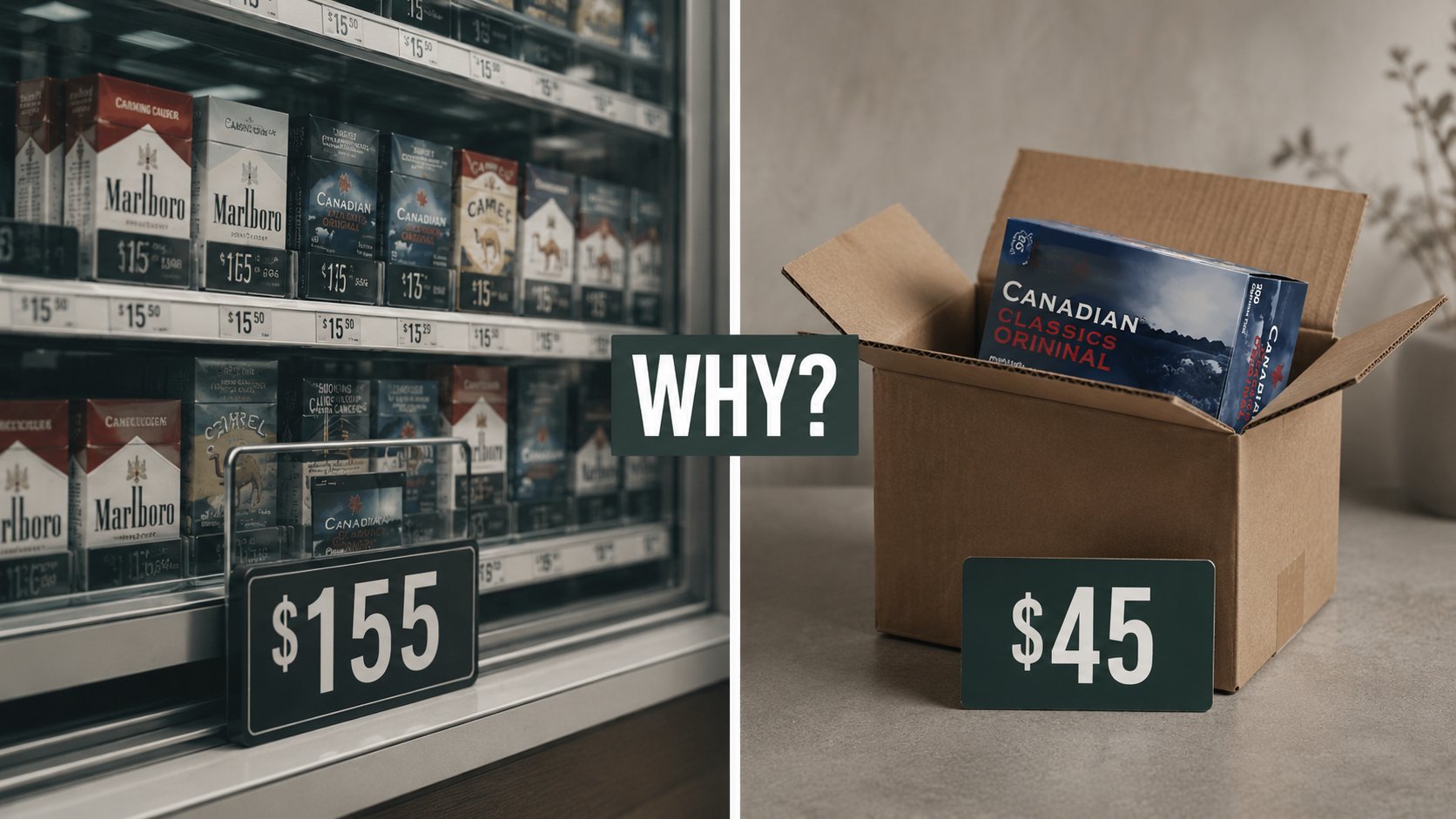
Why are native cigarettes so cheap? The real answer is not one simple loophole. Lower prices can come from a combination of different tax treatment in specific on-reserve transactions, shorter distribution chains, lower retail and brand overhead, direct-to-consumer selling, and bulk quantity discounts.
However, “native cigarette” does not automatically mean tax-exempt for every buyer, legal in every transaction, or identical to a mainstream retail brand. Tobacco tax rules depend on the product, excise stamp, buyer, seller, place of sale, delivery location, and province. That distinction matters because older explanations often overstate Indigenous tax exemptions and make broad legal claims that official government guidance does not support.
This 2026 guide explains the price gap carefully, shows how federal and provincial tobacco taxes affect conventional retail prices, separates tax treatment from supply-chain savings, and explains what adult customers should check before comparing products.
Quick answer
Native cigarette prices can be lower because some products move through different Indigenous economic and tax frameworks, often use shorter supply chains, carry less mainstream brand and storefront overhead, and become cheaper per carton at higher quantity tiers. The exact legal and tax treatment is transaction-specific, so price alone does not prove that a product is tax-exempt or authorized for every buyer.
Why Are Native Cigarettes So Cheap? The Four Main Reasons
Most price differences can be traced to four categories. The weight of each category varies by product and transaction.
1. Tax treatment
Conventional retail cigarettes include federal excise duty, provincial tobacco tax, and applicable sales tax. Certain on-reserve purchases by eligible registered First Nations individuals may receive tax relief under defined rules.
2. Shorter supply chain
A direct manufacturer-to-retailer-to-customer route can involve fewer warehouses, distributors, storefronts, and markups.
3. Lower overhead
Smaller brands and online sellers may avoid national brand premiums, premium shelf fees, franchise costs, and high-rent convenience-store locations.
4. Quantity discounts
The per-carton price can fall when multiple cartons are picked, packed, paid for, and shipped in one transaction.
The first factor is usually the largest when comparing a low-priced carton with a conventional convenience-store carton. The other three still matter because tax is not the only cost built into a retail price.
Important legal distinction
Section 87 of the Indian Act does not create a blanket tax exemption for every non-status customer buying a product labelled “native.” Eligibility and tax treatment depend on the buyer and the specific transaction.
How Tobacco Tax Raises Conventional Retail Cigarette Prices
Duty-paid cigarettes sold through conventional Canadian retail channels can include several layers of government tax before wholesale and retail margins are added.
Federal Excise Duty
The Canada Revenue Agency’s rate effective April 1, 2026 is $0.97299 per five cigarettes or fraction of five. On a standard carton containing 200 cigarettes, that works out to approximately $38.92 in federal excise duty.
Provincial Tobacco Tax
Each province or territory can add its own tobacco tax. Ontario’s published rate is 18.475 cents per cigarette, equal to $36.95 on a carton of 200 cigarettes.
Sales Tax
GST, HST, or provincial sales tax may also apply depending on the province and the transaction. Sales tax is generally calculated on the selling price after other costs have already contributed to that price.
Wholesale and Retail Margins
A conventional retail carton also has manufacturing cost, transportation, warehousing, distributor margin, retailer margin, labour, rent, insurance, compliance, and other operating costs.
Illustrative Ontario Tax Calculation for 200 Cigarettes
Component
2026 Illustrative Amount
What It Represents
Federal cigarette excise duty
Approximately $38.92
CRA rate effective April 1, 2026, calculated for 200 cigarettes.
Ontario tobacco tax
$36.95
Ontario’s published provincial tobacco tax for 200 cigarettes.
Combined excise and Ontario tobacco tax
Approximately $75.87
Before sales tax, manufacturing, distribution, and retailer margin.
Sales tax
Varies with selling price
HST or other applicable sales tax.
Product and commercial costs
Varies
Manufacturing, packaging, distribution, insurance, retail overhead, and margin.
This table is an illustration, not the exact breakdown of every carton. Retail prices vary by province, brand, package size, location, and seller. Still, it shows why a tax-paid carton can become expensive before the convenience store adds its final margin.
Taxes, distribution, overhead, and order size all contribute to the final price difference.
What the Section 87 Tax Exemption Actually Means
Section 87 of the Indian Act provides tax relief for the personal property of a registered Indian or Indian band when the property is situated on a reserve. The Canada Revenue Agency explains that proof of registration is required when claiming the exemption.
For purchases, the key connecting factors include who the buyer is, where the property is purchased or delivered, and whether the specific federal or provincial tax rules recognize the exemption in that situation.
What Section 87 Does Not Mean
It does not mean:
Every product manufactured by an Indigenous business is automatically tax-free.
Every sale occurring on or connected to a reserve is exempt for every buyer.
A non-status customer automatically receives the same exemption as an eligible registered First Nations customer.
Every province treats tobacco transactions identically.
The words “native,” “reserve,” or “First Nations” on a listing establish the product’s legal tax status.
Ontario’s First Nations Cigarette Allocation System
Ontario operates a First Nations Cigarette Allocation System. Ontario’s official guidance says allocation cigarettes may be purchased on reserve by First Nations individuals for their exclusive use and are exempt from Ontario tobacco tax under that system.
That is narrower than the claim that all cigarettes made or sold through Indigenous channels are exempt for the general public.
For a separate legal overview, read Are Native Cigarettes Legal in Canada?. That article is general information and does not replace advice from a qualified lawyer or provincial tax authority.
Excise Stamps, Marked Cigarettes, and Unmarked Tobacco
Price comparisons make more sense when you understand cigarette markings.
Federal Excise Stamps
The CRA states that an excise stamp confirms federal excise duty has been paid on tobacco products when required. Duty-paid cigarette packages sold through ordinary retail channels should carry the applicable stamp.
Provincial Markings
Provinces may also require province-specific markings or adapted federal stamps. The rules differ by jurisdiction.
Unmarked or Unstamped Cigarettes
An unstamped or unmarked product is not automatically authorized for any buyer merely because it originated from First Nations territory. Ontario states that, unless otherwise authorized, it is illegal to buy, possess, sell, or distribute untaxed cigarettes.
Adult customers should not use low price as the only test of legitimacy. Review the product packaging, seller information, applicable province, and official tobacco rules.
Term
General Meaning
What It Does Not Prove
Duty-paid
Required federal duty has been paid and the package carries the applicable federal stamp.
That every provincial rule has automatically been satisfied.
Allocation cigarette
A product distributed under a specific provincial First Nations allocation framework.
That it is tax-exempt for every buyer or may be resold generally.
Unmarked or unstamped
A package lacks the ordinary provincial marking or federal duty-paid stamp.
That it is legal for a non-eligible customer to purchase or possess.
Native cigarette
A broad market term commonly used for First Nations-produced or Indigenous-market tobacco products.
A specific tax, licensing, quality, or legal status.
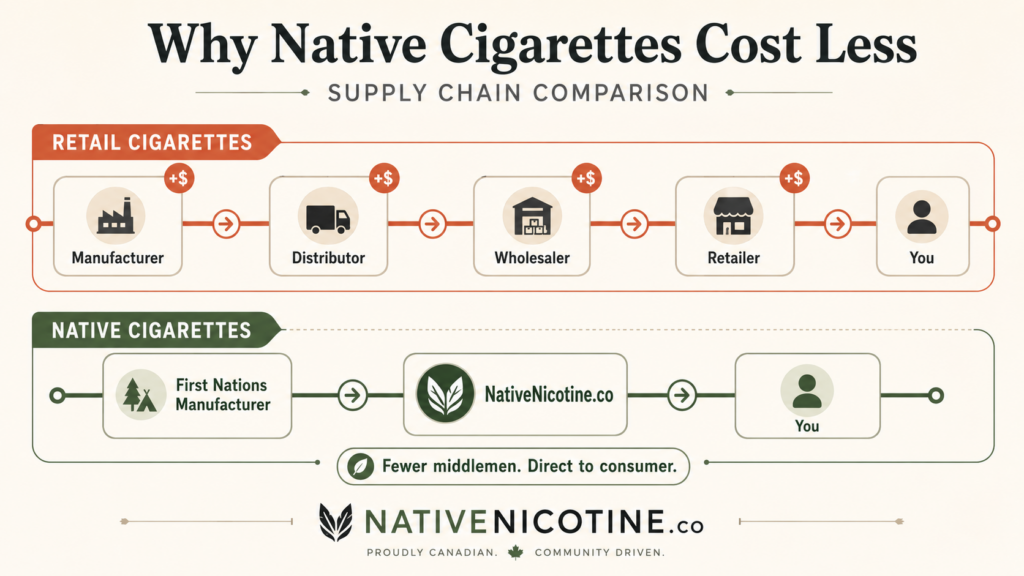
Reason Two: A Shorter Supply Chain Can Reduce the Price
Taxes explain only part of the difference. A product’s route from manufacturer to customer can also materially affect price.
Conventional Retail Supply Chain
Manufacturer produces and packages the cigarettes.
Product enters a regulated distribution and warehousing network.
A wholesaler or distributor supplies regional retail locations.
The retailer pays rent, wages, insurance, utilities, compliance, and franchise or chain expenses.
The final customer pays the shelf price.
Shorter Direct-to-Consumer Supply Chain
Manufacturer supplies the online retailer or warehouse.
The online retailer sells directly to the customer.
One parcel travels to one address.
Removing distribution layers does not remove manufacturing, packaging, warehousing, payment, labour, or shipping costs. It can, however, reduce the number of businesses adding separate margins.
Simple supply-chain comparison
Conventional: manufacturer → distributor → wholesaler → retail store → customer Direct online: manufacturer or supplier → online retailer → customer
Current Native Cigarette Products and Live Pricing
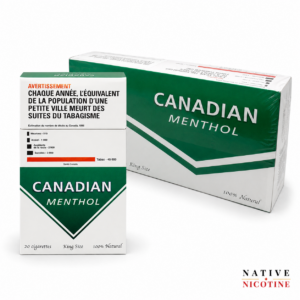
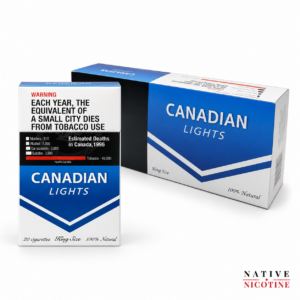
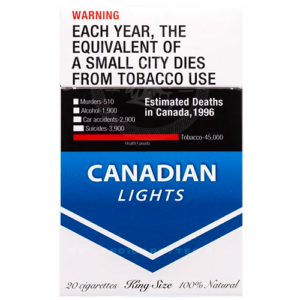
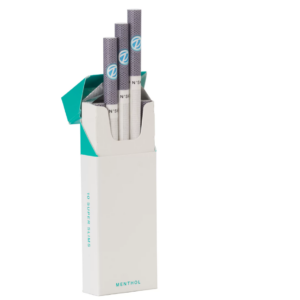
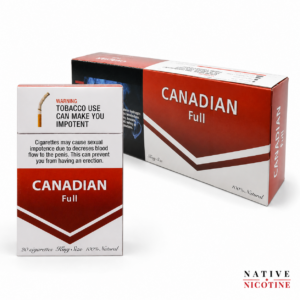
Use live product listings rather than an old article for current prices. The grid below pulls real product photographs, current variations, availability, and pricing directly from WooCommerce.
Mainstream tobacco brands can carry commercial costs associated with national distribution, premium retail positioning, packaging systems, sales organizations, corporate administration, compliance, and brand value.
Canadian tobacco advertising is heavily restricted, so this is not the same as saying modern retail cigarette prices contain large television-ad budgets. The broader point is that established multinational brands and national retail channels carry operating structures that smaller Indigenous brands and online retailers may not.
Potential cost differences include:
Lower-cost online operations compared with high-rent retail locations
No convenience-store franchise markup
Fewer regional sales and distribution layers
Less premium shelf-positioning expense
Smaller corporate and administrative structure
More direct inventory purchasing
This does not mean every Indigenous brand has the same cost structure. It means brand and distribution overhead are separate from tobacco tax and can widen the final price gap.
Reason Four: Bulk Pricing Lowers the Per-Carton Cost
Native Nicotine’s current standard cigarette pricing generally starts at $49 for one carton on participating products, with select 10-carton variations reaching $39 per carton. Single packs start from $5.99 on standard products.
The per-carton price can fall because multiple cartons share:
One checkout
One payment
One order review
One picking and packing process
One shipping label
One parcel destination
Illustrative Native Nicotine Quantity Tiers
Quantity
Typical Standard-Product Positioning
Best Fit
1 pack
From approximately $5.99 per pack
Trying an unfamiliar brand with the lowest commitment.
5 packs
Lower per-pack price on participating products
Testing a product for longer before buying a carton.
1 carton
Standard cartons commonly start from $49
Customers who already know their preferred brand and profile.
5 cartons
Commonly lower per-carton price
Repeat customers and mix-and-match orders.
10 cartons
Select standard products from $39 per carton
Experienced repeat customers comparing maximum bulk value.
Prices and availability can change. Always confirm the live product page and selected variation before checkout.
Pack Size Can Make a “Cheap Carton” Look Cheaper Than It Is
Not every carton contains the same total number of cigarettes. Most standard Native Nicotine cartons contain 10 packs of 20 cigarettes, or 200 cigarettes total. Pop N’ Smoke slim cartons use 10 packs of 10 cigarettes, or 100 cigarettes total.
That means a $49.90 specialty slim carton is not directly equivalent to a $49 standard 200-cigarette carton.
Are Native Cigarettes Lower Quality Because They Are Cheaper?
Price alone does not prove quality in either direction. A lower price does not automatically mean a product is counterfeit or poorly made, but it also does not establish that the product is identical to a mainstream brand.
Quality can vary between manufacturers, brands, batches, storage conditions, and personal preferences. Adult customers should evaluate specific evidence rather than broad claims.
What to Compare
Product format: king size, slim, pack count, and carton count
Profile: full flavour, light-style, menthol, or flavoured
Product photography: real images of the actual package and carton
Packaging condition: seals, printed information, and physical condition
Freshness and storage: stock rotation and warehouse handling
Customer reviews: verified comments about draw, burn, consistency, and condition
Manufacturer and seller information: identifiable business and support details
What Not to Claim
A responsible comparison should not promise that every native cigarette:
Uses the same tobacco blend as a named mainstream brand
Meets an identical manufacturing specification
Contains the same amount of tobacco
Produces the same smoking experience
Is safer because it is “natural,” Indigenous, light, or inexpensive
All cigarettes are addictive and carry serious health risks. “Light” describes a product style or perceived profile, not a safer product.
The cheapest sticker price is not always the best value. Compare the complete order.
Value Factor
Question to Ask
Pack and carton count
How many cigarettes am I actually receiving?
Selected quantity tier
Is the displayed “from” price based on one carton or ten cartons?
Shipping
Does the order qualify for free shipping over $149?
Product familiarity
Have I tried this brand before buying multiple cartons?
Profile match
Does the full, light-style, menthol, or slim profile match what I already prefer?
Live availability
Is the product actually in stock in my selected variation?
Reviews
What do verified customers say about draw, consistency, and packaging?
Legal and tax context
What rules apply to the product and transaction in my province?
Simple Cost-per-Cigarette Formula
Total product price ÷ total cigarettes = cost per cigarette.
Example:
A $49 standard carton containing 200 cigarettes costs approximately 24.5 cents per cigarette before any shipping allocation.
A $49.90 slim carton containing 100 cigarettes costs approximately 49.9 cents per cigarette before any shipping allocation.
This is why quantity and format matter as much as the carton headline.
How Much Can an Adult Smoker Save?
The potential saving depends on the actual retail price, native product, quantity tier, shipping, and smoking frequency. Avoid using one national savings claim for every customer.
Illustrative Comparison
Example Carton Price
Difference Versus $49 Carton
Difference Across 12 Cartons
$120 retail
$71 per carton
$852
$140 retail
$91 per carton
$1,092
$160 retail
$111 per carton
$1,332
$180 retail
$131 per carton
$1,572
These are mathematical examples, not guaranteed savings. The correct comparison uses your local retail price, the live Native Nicotine product price, total cigarette count, shipping, and actual order frequency.
Native Nicotine currently uses Interac e-Transfer. Orders are processed after payment is received and matched. Tracking is emailed after shipment, and qualifying orders of $149 or more receive free shipping.
General delivery estimates are:
British Columbia, Alberta, Saskatchewan, and Manitoba: 2 to 4 business days
Ontario and Quebec: 4 to 6 business days
Atlantic Canada: 6 to 9 business days
Territories and many remote northern addresses: 7 to 14 business days
These estimates begin after payment confirmation and processing and are not guaranteed arrival dates.
Frequently Asked Questions About Cheap Native Cigarettes
Why are native cigarettes so cheap?
Prices can be lower because of different tax treatment in specific eligible transactions, shorter distribution chains, lower brand and retail overhead, direct online selling, and bulk quantity discounts. The exact tax and legal treatment depends on the product, buyer, seller, sale location, delivery location, and province.
Are native cigarettes tax-free for everyone?
No. Section 87 of the Indian Act applies to eligible registered First Nations individuals and qualifying property situated on a reserve. It is not a blanket exemption for every customer or every product labelled “native.”
How much federal excise duty applies to a standard carton in 2026?
The CRA rate effective April 1, 2026 is $0.97299 per five cigarettes or fraction of five. For 200 cigarettes, that is approximately $38.92 in federal excise duty when the duty applies.
How much Ontario tobacco tax applies to 200 cigarettes?
Ontario publishes a tobacco tax of 18.475 cents per cigarette, equal to $36.95 for 200 cigarettes.
Does an unstamped package mean the cigarettes are legal to buy?
No. The absence of a stamp does not establish that a product is authorized for a particular buyer. Provincial and federal rules apply, and Ontario states that untaxed cigarettes are illegal to buy, possess, sell, or distribute unless otherwise authorized.
Are native cigarettes lower quality because they cost less?
Price alone does not prove quality. Compare the actual manufacturer, product format, packaging, storage, reviews, draw, burn, and consistency. Native cigarettes should not be assumed identical to a mainstream brand without evidence.
Why do ten cartons cost less per carton?
Multiple cartons can share one checkout, payment, order review, picking process, box, label, and delivery address. That operational efficiency can support a lower per-carton price.
Are all cartons 200 cigarettes?
No. Standard Native Nicotine cartons generally contain 10 packs of 20 cigarettes, or 200 total. Pop N’ Smoke slim cartons contain 10 packs of 10 cigarettes, or 100 total. Confirm the live product page.
What is the cheapest way to try native cigarettes?
A single pack or 5 Pack Mix & Match Bundle usually has less commitment than buying an unfamiliar carton. The lowest unit price is not always the best first purchase.
Do native cigarettes have the same health risks as retail cigarettes?
All cigarettes are addictive and carry serious health risks. Lower price, Indigenous origin, natural claims, or light-style labelling do not make smoking safe.
Are native cigarettes legal for non-Indigenous customers?
The legal answer depends on the product and province, including its tax-paid or marked status and the circumstances of sale and possession. Do not rely on a blanket statement. Review official provincial guidance and obtain legal advice for a specific situation.
What should I compare before ordering?
Compare total cigarettes, selected quantity, cost per cigarette, shipping, product profile, live stock, reviews, legal-age requirements, and the current rules that apply in your province.
The Bottom Line
Why are native cigarettes so cheap? The price gap can reflect a combination of tax treatment in specific eligible transactions, shorter distribution, lower brand and storefront overhead, and bulk-order efficiency.
The most important correction to the common explanation is that Indigenous tax relief is not a universal exemption for every customer. “Native cigarette” is a broad market label, not proof that every sale is tax-free, authorized, or identical in quality to a mainstream retail product.
Adult customers comparing value should use live prices, confirm the total cigarette count, review the product and seller, understand the tax and legal context, and avoid buying an unfamiliar product solely because the carton price is low.
Compare current products and quantities
Shop native cigarette packs, cartons, and bundles.
Review live pricing, real product photographs, total quantities, customer ratings, shipping terms, and available variations before ordering.