Native Cigarettes vs Regular Cigarettes: What’s Actually Different? (2026)
Last updated: May 11, 2026. For Canadian adults 19+ (18+ in Quebec). Educational comparison of native cigarettes and mainstream retail cigarettes in Canada.
If you’ve been thinking about ordering native cigarettes online but you’re still smoking du Maurier or Belmont or Player’s from the gas station, you almost certainly have the same questions every other Canadian smoker has before they switch:
Are they actually the same cigarette? Will they taste different? Are they real, or are they some kind of off-brand knockoff? Is it legal for me to buy them? And if they’re so much cheaper, what’s the catch?
This guide is a head-to-head comparison of native cigarettes and regular (mainstream retail) cigarettes in Canada – covering the tobacco, the manufacturing, the taste, the legality, the price, and the practical experience of smoking one vs the other. We sell native cigarettes, so we have a perspective. But the goal of this article is to give you the actual facts so you can decide for yourself.
The Short Answer
Native cigarettes and regular cigarettes are fundamentally the same product: full-size, 20-pack king-size cigarettes made from real tobacco, manufactured in Canada, and sold to adult Canadian smokers. The differences between them fall into five clear categories:
Where they’re made. Native cigarettes are produced on First Nations territory by Indigenous-owned manufacturers. Regular cigarettes come from large multinational tobacco companies (Imperial Tobacco, JTI-Macdonald, Rothmans Benson & Hedges).
How they’re taxed. Native cigarettes are exempt from most federal and provincial tobacco tax under Indigenous tobacco rights. Regular cigarettes carry $90-$110 of tax per carton.
How you buy them. Regular cigarettes are sold at licensed retail (gas stations, convenience stores). Native cigarettes are sold direct-to-consumer through Indigenous economic channels and online retailers like NativeNicotine.co.
How much they cost. Regular cartons run $130-$160 at retail. Native cartons run $39-$49 direct.
Brand experience. Regular brands have global marketing legacies. Native brands like Canadian Classics, Playfare, BB, and Canadian are positioned as direct, no-frills alternatives.
What native cigarettes are not: contraband, illegal, knockoffs, lower-quality, smaller, or weaker. They are full-strength tobacco products manufactured in Canada, just outside the mainstream retail tobacco distribution system. The rest of this guide explains each of the differences in detail.
Quick Side-by-Side Comparison
Factor
Native Cigarettes
Regular (Retail) Cigarettes
Pack size
20 cigarettes (king size)
20 cigarettes (king size)
Carton size
10 packs / 200 cigarettes
10 packs / 200 cigarettes
Tobacco
Real tobacco, Canadian-grown or sourced
Real tobacco, Canadian-grown or imported
Manufactured
On First Nations territory in Canada
In Canada (Imperial, JTI, RBH facilities)
Tobacco tax
Exempt under Indigenous tobacco rights
$90-$110+ per carton
Price per carton
$39-$49
$130-$165
Price per pack
$3.90-$5.99
$13-$16+
Where to buy
Online retailers, on-reserve smoke shops
Gas stations, convenience stores, grocery
Legal for adults to buy
Yes (19+, 18+ in Quebec)
Yes (19+, 18+ in Quebec)
Menthol available
Yes (one of the only legal sources in Canada)
No (banned at retail since 2017)
Plain packaging requirement
No (own packaging design)
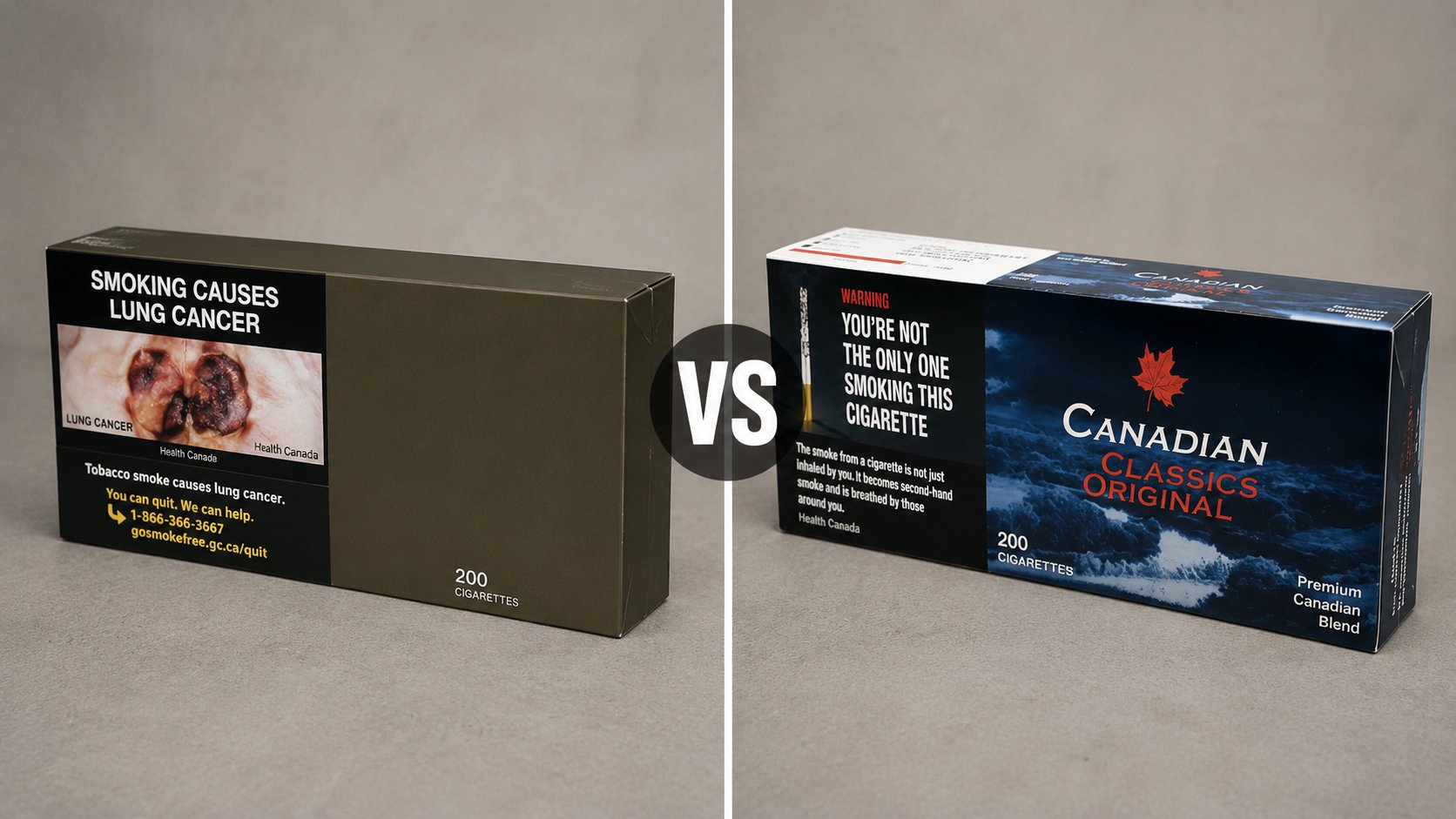
Yes (federal plain packaging law since 2019)
Brand examples
Canadian Classics, Playfare, BB, Canadian
du Maurier, Belmont, Player’s, Export A, Matinee
Difference 1: Where They’re Manufactured
Both native and regular cigarettes are physically made in Canada. The difference is who makes them and where.
Regular cigarettes
Canada’s mainstream cigarette market is dominated by three multinational tobacco companies: Imperial Tobacco (subsidiary of British American Tobacco), JTI-Macdonald (subsidiary of Japan Tobacco International), and Rothmans, Benson & Hedges (subsidiary of Philip Morris International). They operate large-scale manufacturing facilities in Canada and distribute through provincial tobacco distribution networks to licensed retail.
Native cigarettes
Native cigarettes are manufactured on First Nations territory by Indigenous-owned tobacco companies. The two largest manufacturing centres are in southern Ontario (Six Nations of the Grand River) and Akwesasne (which straddles the Ontario-Quebec-New York border). These facilities produce a range of brands that are distributed through Indigenous economic channels and direct-to-consumer e-commerce.
The tobacco itself is real tobacco, sourced through legitimate agricultural supply chains. The manufacturing equipment and processes are comparable to mainstream operations. The fundamental product – a king-size filtered cigarette – is the same.
Difference 2: The Tax Structure
This is the single biggest practical difference between native and regular cigarettes, and it’s where the price gap comes from.
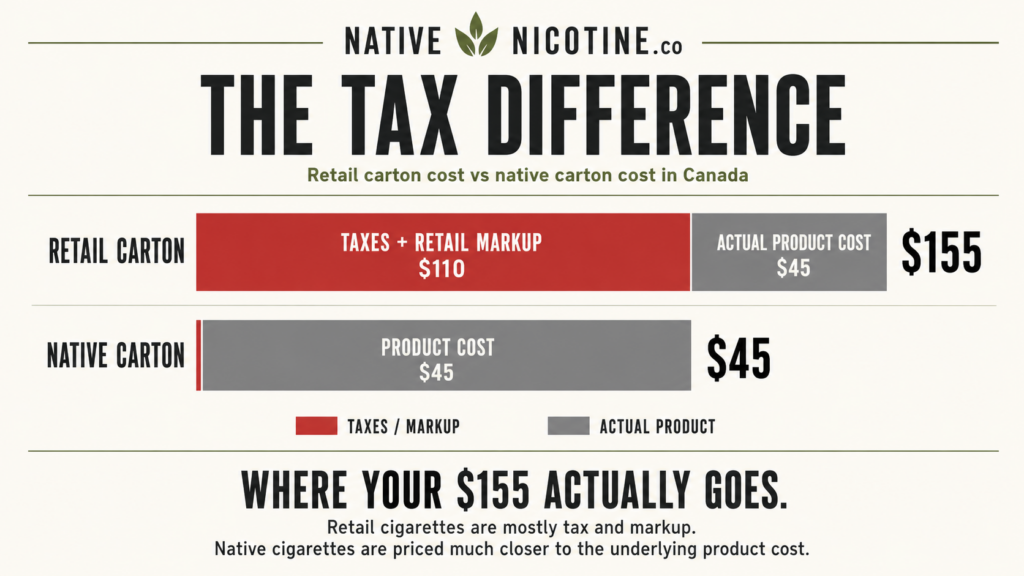
A carton of regular cigarettes at a Toronto gas station for $155 contains roughly $108 in combined federal excise tax, provincial tobacco tax, and HST. The actual product cost — tobacco, manufacturing, packaging, brand, retail margin — is about $47 of that $155. The rest is tax.
Native cigarettes manufactured under Indigenous tobacco rights on First Nations territory are exempt from federal excise tax and provincial tobacco tax. The exemption is grounded in Section 87 of the Indian Act and various provincial tobacco tax statutes, and it has been in place for decades.
The practical effect: same cigarette, no tax burden, dramatically lower price.
Difference 3: Taste and Smoking Experience
This is the question every smoker actually wants answered: will it taste the same as what I’m smoking now?
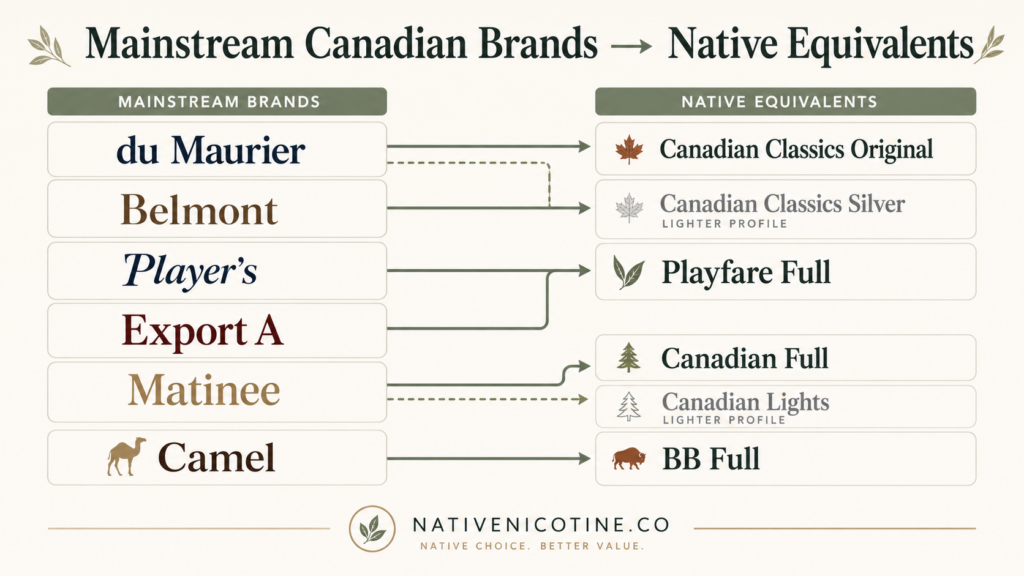
Honest answer: native cigarettes don’t taste identical to mainstream brands, but they’re not meant to. Each native brand is its own product with its own tobacco blend and flavour profile. What we can do is map the most common mainstream brands to their closest native equivalents.
The smart approach for a first-time native smoker is to not pick one brand and commit. Order a 5 Pack Mix & Match Bundle at $27.45 and sample five different packs across our four brand families. You’ll know your everyday native brand within a week, and you can scale up to a carton or 5-carton order from there.
Difference 4: How You Buy Them
This is where the practical experience genuinely differs.
Regular cigarettes
Walk into any gas station or convenience store in Canada, ask for your brand, show ID if requested, pay $13-$16 per pack or $130-$160 per carton, walk out. Federally mandated plain packaging since 2019 means every carton looks like every other carton – drab brown box, graphic health warnings, no brand colours.
Native cigarettes
You order online from a site like NativeNicotine.co, complete age verification, pay by Interac e-Transfer, and your order ships in plain unmarked packaging with tracking. Delivery takes 3-7 business days depending on your province (3-4 days in Ontario, 4-6 days in BC, 5-7 days in Atlantic Canada).
For a step-by-step walkthrough of the entire ordering process, see how to buy cigarettes online in Canada. New customers occasionally find the e-Transfer step unfamiliar — it’s the same process you’d use to send money to a friend through your online banking, and it’s the most secure payment method available for this category in Canada.
The trade-off
Regular cigarettes are convenient (instant gratification). Native cigarettes require planning ahead (a 3-7 day shipping window) but you save $90-$120 per carton. Most regular customers stock up with 5 or 10 cartons at a time using bundles like the 5 Carton Mix & Match Bundle, which gets them past the $199 free shipping threshold and provides 5-10 weeks of supply. With that approach, the inconvenience disappears.
Difference 5: The Menthol Question
This is a difference that doesn’t show up in price comparisons but matters enormously to a specific group of smokers. In 2017, the Canadian federal government banned menthol cigarettes from mainstream retail. If you were a menthol smoker before 2017, your brand simply vanished from gas stations across the country.
Indigenous tobacco businesses are not bound by the menthol retail ban because of the same exemption framework that drives the tax difference. Canadian Menthol is one of the only legal sources of menthol cigarettes in Canada in 2026, and it’s one of the most popular individual products in our menthol cigarettes category.
For former menthol smokers who switched to non-menthol alternatives reluctantly after 2017 – or who switched to nicotine pouches, vapes, or quit entirely — this is often the single biggest reason to consider native cigarettes.
Difference 6: The Price Gap (Real Numbers)
For a regular smoker, the dollar difference between native and regular cigarettes compounds quickly. Here’s the real-money comparison for typical Canadian smoking frequencies:
Common Questions About Native vs Regular Cigarettes
Are native cigarettes the same as regular cigarettes?
They are the same fundamental product – full-size, 20-pack king-size cigarettes made from real tobacco, manufactured in Canada — but they are sold outside the mainstream retail tobacco distribution system. Native cigarettes are produced on First Nations territory under Indigenous tobacco rights, which exempts them from most federal and provincial tobacco tax. The result is a 60-75% price difference vs retail.
Do native cigarettes taste different than regular cigarettes?
Each native brand has its own tobacco blend and flavour profile, so the experience varies by brand. None of them taste identical to mainstream brands like du Maurier, Belmont, or Player’s, but each native brand maps to a specific style – refined premium, traditional everyday, smooth balanced, or bold full-body. Most first-time native smokers find their preferred brand within 3-5 packs. The 5 Pack Mix & Match Bundle is designed for exactly this sampling process.
Are native cigarettes weaker than regular cigarettes?
No. Native cigarettes are full-strength tobacco products. Full-flavour native brands like BB Full or Canadian Full are equivalent in strength to mainstream full-flavour brands. Light variants like Canadian Classics Silver or Playfare Light are equivalent to mainstream lights.
Are native cigarettes illegal or contraband?
No. Native cigarettes manufactured on First Nations territory under Indigenous tobacco rights are legal products. Adult Canadians (19+, 18+ in Quebec) can legally purchase them for personal use. The full legal framework – including how it applies to non-Indigenous buyers – is covered in our native cigarettes legality guide.
Why don’t gas stations and convenience stores sell native cigarettes?
Provincially licensed tobacco retailers are required to sell only tax-paid product through the provincial tobacco distribution system. Native cigarettes flow through a parallel Indigenous economic framework. Direct-to-consumer e-commerce is the standard way for non-Indigenous Canadians to access these products legally and conveniently.
Are native cigarettes safe? Are they regulated for health and safety?
All cigarettes – native, regular, mainstream, or otherwise – carry serious health risks. Nicotine is addictive, and smoking is associated with cardiovascular disease, respiratory disease, and cancer regardless of brand or source. Native cigarettes are not marketed as safer than regular cigarettes, and we don’t claim they are. What native cigarettes offer is a price-equivalent product to mainstream brands, not a health-equivalent alternative. If you are concerned about tobacco use, Health Canada offers resources for quitting smoking, and tobacco-free nicotine pouches are a smokeless alternative to consider.
Do native cigarettes have the same health warnings as regular cigarettes?
Native cigarette packaging is not subject to the same federal plain packaging requirements as mainstream retail cigarettes (which has been in effect since November 2019). Native brands typically have their own designed packaging. Health warnings about nicotine and tobacco still apply universally — nicotine is addictive and tobacco use causes serious health harm regardless of where the product comes from.
Can I mix native and regular cigarettes?
Yes. Many of our customers keep native cigarettes as their everyday smoke for cost reasons and pick up an occasional pack of a mainstream brand at retail if they’re caught short between deliveries. Others switch fully to native and never go back. There is no functional reason you can’t move between them.
Who Should Switch and Who Shouldn’t
Switching to native cigarettes makes sense if…
You smoke regularly (at least a few packs a week) and the cost of mainstream cigarettes is meaningfully affecting your budget
You used to smoke menthol before the 2017 retail ban and want a legal source again
You don’t mind ordering online and planning a few days ahead for delivery
You’re open to trying a new brand – you’ll most likely find one you prefer to what you’re smoking now
You’re comfortable with Interac e-Transfer as a payment method
Sticking with regular cigarettes makes sense if…
You smoke very infrequently and the dollar savings don’t matter to you
You strongly prefer a specific mainstream brand and aren’t interested in trying alternatives
You need cigarettes available in real-time (no ability to plan 3-7 days ahead)
You don’t use online banking and can’t easily send an Interac e-Transfer
For most regular smokers, the math points to native. The 5 Pack Mix & Match Bundle exists specifically to let you test the switch at $27.45 of risk — sample five different packs across four brands, identify your everyday smoke, and decide from there.
The Bottom Line
Native cigarettes are real cigarettes. They are not knockoffs, contraband, or lower-quality. They are full-strength tobacco products made in Canada by Indigenous-owned manufacturers, sold outside the mainstream retail system, exempt from most tobacco tax, and priced 60-75% below what you’d pay at a gas station.
The differences between native and regular cigarettes are in how they reach you, who makes them, how they’re taxed, and what brand experience surrounds them. The cigarette itself — the tobacco, the format, the smoking experience – is fundamentally the same category of product. Which one you smoke comes down to whether you want to keep paying gas station tax markups or not.
Disclaimer: This article is for informational purposes only and does not constitute medical, legal, or tax advice. Tobacco is harmful regardless of source. Nicotine is highly addictive. NativeNicotine.co sells exclusively to Canadian adults 19 years of age or older (18+ in Quebec). For health concerns related to smoking, see Health Canada’s quit smoking resources.
Last updated: May 11, 2026. For Canadian adults 19+ (18+ in Quebec). Educational content on Canadian tobacco taxation and Indigenous tobacco rights. If you’ve ever picked up a carton of cigarettes at a gas station in Toronto for $155 and then seen the same-sized carton on NativeNicotine.co for $39 to
Last updated: April 22, 2026. For Canadian adults 19+ (18+ in Quebec). Informational comparison only. If you search “buy native cigarettes online Canada,” Google returns dozens of sites. Prices, brand selection, shipping speeds, payment methods, and trust signals vary wildly between them. Some have been operating for over a decade.
How to Buy Cigarettes Online in Canada — The Complete 2026 Guide Buying cigarettes online in Canada is legal, safe, and — when done right — dramatically cheaper than buying at a gas station or convenience store. If you’ve never ordered cigarettes online before, this step-by-step guide walks you through
🍁 ONE TIME OFFER
Save $20 on your first 5 carton order.
Plus free shipping. Drop your name and email and we'll send the code now.
No spam. Unsubscribe anytime. 19+ to subscribe (18+ in QC).